| During vehicle Pre-Delivery Inspection:
Air Conditioning not blowing cold air |
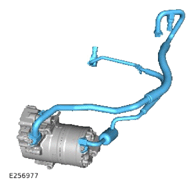 Courtesy of JAGUAR LAND ROVER NORTH AMERICA, LLC Courtesy of JAGUAR LAND ROVER NORTH AMERICA, LLC
- Low pressure in the system due to twisted or kinked air conditioning inlet pipe
|
- If the pressure is low due to a twisted or kinked air conditioning inlet pipe, install a new air conditioning inlet pipe
|
| Customer returning the vehicle:
Air Conditioning not blowing cold air |
Courtesy of JAGUAR LAND ROVER NORTH AMERICA, LLC
- Low pressure in the system due to twisted or kinked air conditioning inlet pipe
|
- If the hose is found to be twisted/kinked replace the hose and compressor (the compressor may have become damaged due to oil starvation)
|
| No refrigerant in air conditioning system (no pressure registered on gauges) |
|
|
| Air conditioning inoperative (no change in pressure when setting the air conditioning to on) |
- Climate control system fault
- Air conditioning compressor internal failure
- HV
system fault
|
- Using the Jaguar Land Rover Approved Diagnostic Equipment, check the HVAC Control Module for related Diagnostic Trouble Code(s) (DTC)s and refer to the relevant DTC
index
- GO to PINPOINT TEST B .
- GO to PINPOINT TEST C .
- GO to PINPOINT TEST D .
|
| Air conditioning operates briefly and then switches off |
- Electric cooling fan inoperative
- Air conditioning condenser airflow obstructed
- Refrigerant overcharged
- Refrigerant under charged
|
- Check the operation of the electric cooling fan
- Check the air conditioning condenser for external obstructions
- Using the Jaguar Land Rover Approved Diagnostic Equipment, check the HVAC Control Module for related DTC
and refer to the relevant DTC
index
- Using the Jaguar Land Rover Approved Equipment, recover the refrigerant. Evacuate and recharge the air conditioning system with the correct quantity of refrigerant and oil
|
| High and low pressure system pressures Unstable |
- Excessive volume of oil in the refrigerant
|
- Excessive oil can be due to a replacement compressor. Follow the recommended compressor and oil replacement procedure
- Using the Jaguar Land Rover Approved Equipment, recover the refrigerant. Flush oil from the system and recharge the air conditioning system with the correct quantity of refrigerant and oil
|
| High and low pressure system pressures normal and insufficient cooling |
- Temperature blend door fault
|
- Using the Jaguar Land Rover Approved Diagnostic Equipment, check the HVAC Control Module for related DTC
and refer to the relevant DTC
index
- GO to PINPOINT TEST F .
|
| High and low pressure system pressures too high |
- Electric cooling fan inoperative
- Front cooling module active grille inoperative
- Air conditioning condenser airflow obstructed
- Orifice tube blocked
- Refrigerant overcharged
- Excessive volume of oil in refrigerant system
|
|
| High pitched hissing noise can be heard from behind the instrument panel when the A/C
system is on (most prominent when a low fan speed is selected and at lower vehicle speeds) |
- A/C
orifice tube hiss - liquid refrigeration is passing through the orifice tube on its way to the evaporator, causing a hissing sound. The sound is then amplified through the A/C
pipe vibration
|
NOTE:
This repair procedure is only applicable to 19-20MY I-PACE (X590) vehicles with a Vehicle Identification Number (VIN) range from SADHA2B11K1F76542 up to SADHA2A18L1F79828
- Wrap the A/C
pipe using kit: L9D3-19E959-AA/T4K12876 following the process listed below
|
| Musty/damp odor emitting from the climate control system when the air conditioning system is operated |
- Bacterial growth in the climate control system
|
- Should a customer express this concern, follow the service instruction below - 'Clean The Climate Control System'
|