Vehicle Rises Abnormally
- If vehicle height is excessive, check for defective height sensor, control unit, solenoid valve or wire circuit. Check if No. 12 or 20 fuse is blown and replace as necessary. If fuses are okay, check voltage across control unit terminals No. 31 and 20 (ground). Ensure voltage is over 10 volts with ignition on. If not, check ignition power and ground for breaks. If okay, go to next step.
- Ensure 10 volts or more is present between control unit terminals No. 29 and 20 (ground) when height control switch is pressed. If okay, go to next step. If not, ensure ignition voltage is flowing to height control switch. If not, there is defective wiring between ignition switch and height control switch. If ignition voltage is present, there is defective wiring between height control switch and control unit.
- Check if vehicle height sensor light comes on when height control switch is operated. If okay, go to next step. If not, see if light comes on when control unit terminal No. 2 is grounded. If okay, go to next step. If not, see if bulb is defective, ignition voltage is inputted to vehicle height indicator, or if there is a broken circuit between vehicle height indicator light and control unit.
- Check if vehicle height indicator light goes out when height control switch is operated. If okay, go to next step. If not, check if vehicle height indicator light goes out when 2 control unit connectors are disconnected. If light goes out, replace control unit. If not, there is defective wiring between vehicle height indicator light and control unit.
- Check solenoid valve and compressor operation by grounding terminals. If okay, go to next step. If not, solenoid valve, compressor and compressor relay are defective as a single unit.
- Check if right front suspension lowers when terminals No. 18 and 11 of control unit are simultaneously grounded. Check if left front suspension lowers when terminals No. 11 and 15 are grounded. Check if right rear suspension lowers when terminals No. 11 and 16 are grounded. Check if left rear suspension lowers when terminals No. 11 and 17 are grounded. If okay, go to step 8). If not, go to next step.
- If vehicle height does not lower at any single wheel there is a faulty air discharge valve. If vehicle height does lower at some wheels, there are faulty solenoid valves or clogged air lines.
- Remove No. 19 fuse and turn ignition on. Measure voltage across control unit terminals while raising vehicle with a jack. Push height control switch to set vehicle in "HIGH" position. Repeat voltage measurements across terminals. Measure right front suspension voltage as follows:
- Ensure voltage across terminals No. 27 and 20 ("GND") is about 5 volts.
- Ensure voltage across terminals 35 and 20 is about zero volts.
- Slowly raise vehicle with a jack until voltage across terminals No. 35 and 20 changes from zero to 5 volts.
- Ensure voltage across terminals No. 27 and 20 is about 5 volts.
- Slowly raise vehicle with a jack until voltage across terminals No. 27 and 20 changes from 5 to zero volts.
- Ensure voltage across terminals No. 35 and 20 is about 5 volts.
- Each strut must be checked in a similar manner with vehicle set from "NORMAL" to "HIGH" and from "HIGH" to "NORMAL". See Fig 1. Proceed to next step.
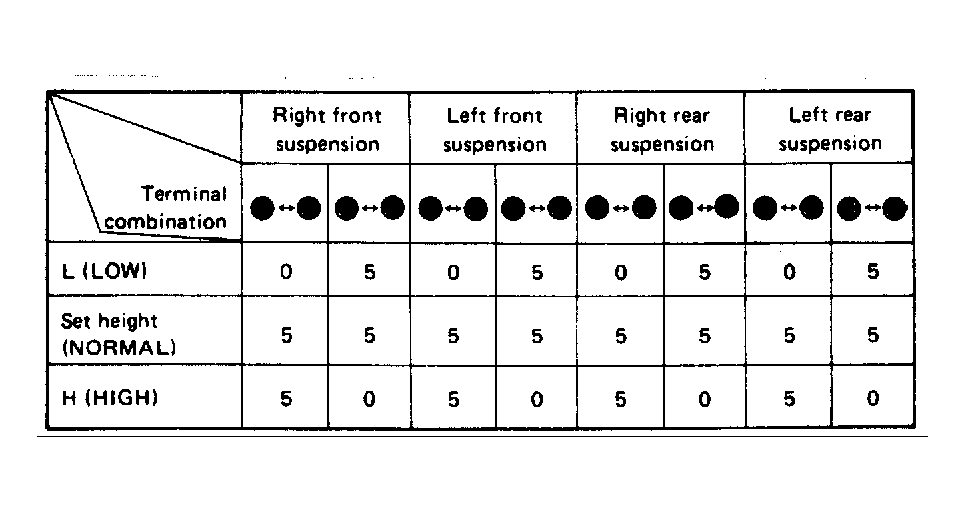 Courtesy of SUBARU OF AMERICA, INC.
- If all testing indicates electrical system is okay, check air lines, pressure switch and air tank for malfunction. If complete system did not operate properly in previous test, check vehicle height sensor. If okay, replace affected strut.