Turbocharger Air Bypass Valve - Problem Diagnosis
90saab06 CATEGORY EngineSECTION PAGE
2 5
ISSUE CODE
10/90-0034 291
Subject: Diagnosing a Leaking Air
Bypass Valve
Application: 900 and 9000 Turbo Models, 1985-
If a 900 or 9000 Turbo model develops a complaint of driveability problems or even engine stalling, it may be the result of a leaking diaphragm within the air bypass valve. In order to help diagnose a problem related to the air bypass valve, it is essential to know the function of the valve and how it operates.
Bypass Valve Function
The function of the turbo air bypass valve is to redirect turbo pressure in the inlet system when the throttle is closed quickly. The valve is operated using engine vacuum against a spring-loaded diaphragm. When the throttle enclosed suddenly while the turbo is generating boost pressure, the valve opens to divert the pressure back to the suction side of the turbo. This is done to prevent pressure waves from bouncing off the closed throttle plate causing surging or noise when the throttle is reopened.
Bypass Valve Operation-Throttle Open
Whenever the throttle is open and the turbo is generating boost, positive pressure is present inside the intercooler, delivery pipes, throttle housing, and the intake manifold. At the same time, a vacuum is formed in the inlet pipe between the air cleaner and the compressor side of the turbo.
Figure 1:
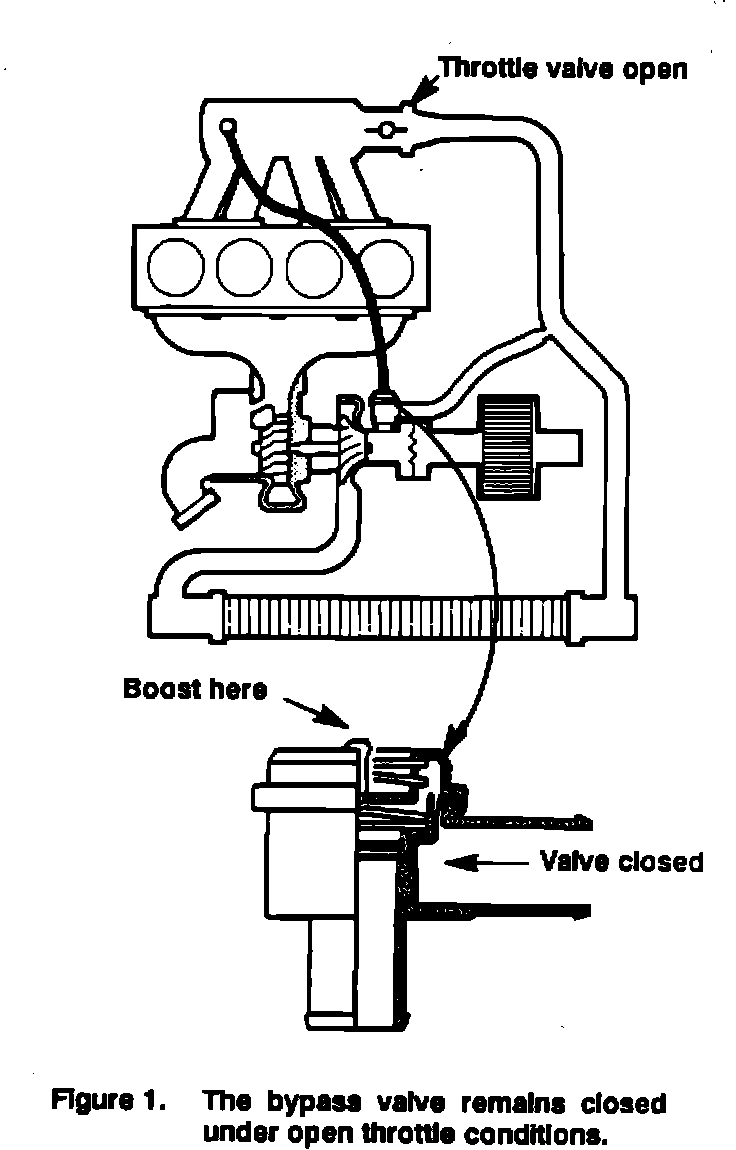
As long as the throttle is open, boost pressure acts on both sides of the diaphragm in the valve. The valve is held closed by the combined effort of the spring inside the valve and the boost press tire from the intake manifold (See Figure 1).
Bypass Valve Operation-Throttle Closed
When the throttle is closed, a vacuum is quickly formed inside the intake manifold due to engine combustion. However, boost pressure remains in delivery pipes between the turbo and the closed throttle plate.
To stop a sudden rise in pressure inside the intake manifold when the throttle is reopened, the excess boost pressure is diverted back to the turbo through the bypass valve. If the sudden rise in pressure is not diverted, engine perfoanance can be jerky and there may be harsh movements in the powertrain.
Figure 2:
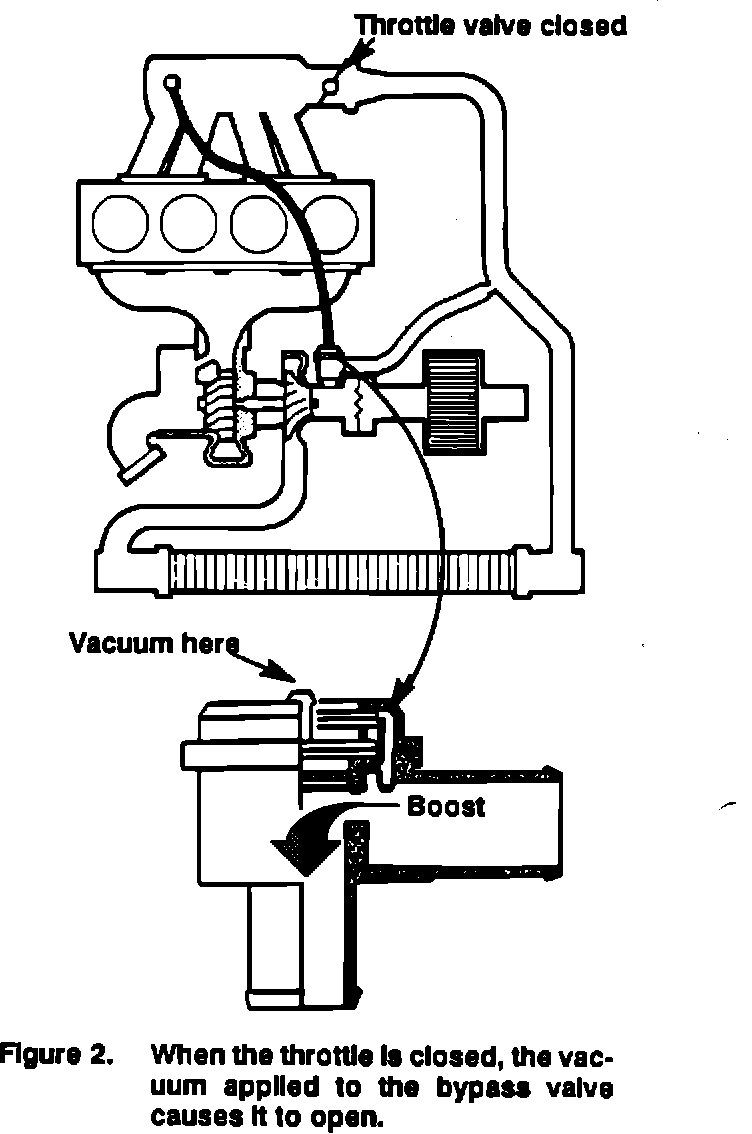
Whenever there is a vacuum in the intake manifold, the same vacuum is applied to the spring side of the bypass valve. Since the force of the spring alone is not sufficient to counter the boost pressure acting on the other side of the diaphragm, the valve opens, dumping the pressure trom the delivery pipe and throttle housing back into the intake pipe upstream of the compressor. (See Figure 2)
Diagnosing a faulty valve
If a leak develops in the bypass valve diaphragm, the valve will not open when the throttle is closed, possibly causing driveability problems. The engine may even stall because the boost pressure, which is bypassing the closed throttle plate, creates a lean airfuel mixture. A leaking bypass valve may also set various LH and/or DI/APC system fault codes.
Tools required:
Hand-held vacuum pump
Procedure
1. Park the car and switch off the ignition.
2. Follow the vacuum hose from the bypass valve to the intake manifold vacuum nipple. Disconnect the hose from the nipple.
3. Connect the vacuum pump to the hose and pump down the valve.
4. If the valve will not hold a vacuum, the diaphragm is leaking. Replace the bypass valve as needed.
5. Reconnect the vacuum hose to the vacuum nipple.
Warranty Information:
For warranty repairs use Failure Coding 29153-50-0-01-01. Time allowance is Labor Operation No. 29153.