Caster and Camber
Fig. 1 Front Suspension Height Measurement. 2WD:
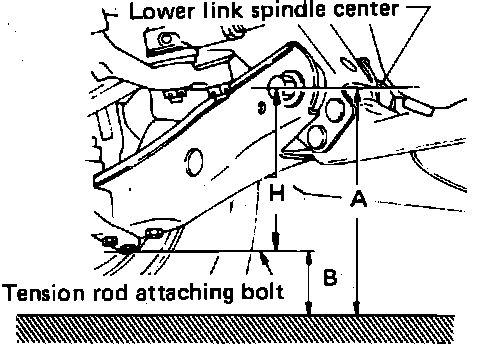
Caster and camber are adjusted together by varying the thickness of shims between the upper control arm shaft and crossmember. To check and adjust caster and camber, proceed as follows:
1. Prior to checking and adjusting caster and camber, ensure front suspension height is within specifications as follows:
a. Measure suspension height of suspension arm pivot (A) and height of tension rod attaching bolt or steering stopper bracket (B), Fig. 1.
b. Subtract measurement (B) from measurement (A) to determine suspension height (H). It should measure 4.37-4.53 inches.
c. If vehicle height is not within specifications, jounce vehicle several times to settle suspension. If height is still not within specifications, check suspension and repair or replace component as needed before continuing with alignment procedure.
2. Check caster and camber and refer to wheel alignment specifications.
3. If caster and or camber are not within specifications, place suitable jack under lower control arm, raise arm to remove tension from upper control arm and loosen nuts securing upper control arm to crossmember.
4. Replace shims between upper control arm shaft and crossmember, noting the following:
a. Do not use more than three shims at any one position, and ensure shim thickness does not exceed 0.315 inch (8 mm).
b. When installing shims with a right angle tab at the top, ensure tab faces control arm shaft, insert shim from bracket side and only use one shim of this type at any one position.
c. To adjust caster, vary thickness of shims between front and rear positions. When thickness of front shim is increased, caster decreases. When increasing shim thickness at the rear position, caster increases. When performing adjustment, ensure difference in shim thickness between front and rear positions does not exceed 0.079 inch (2 mm). Camber angle is affected by varying shim thickness to perform caster adjustment. Always adjust caster angle first, then reduce or increase shim thickness equally at front and rear positions to adjust camber.
d. To adjust camber, add shims of equal thickness to both front and rear positions to move camber toward a more positive value, or decrease shim thickness equally at front and rear positions to move camber toward a more negative value.
5. Tighten upper control arm nuts and ensure caster and camber are still within specifications.