Road Test
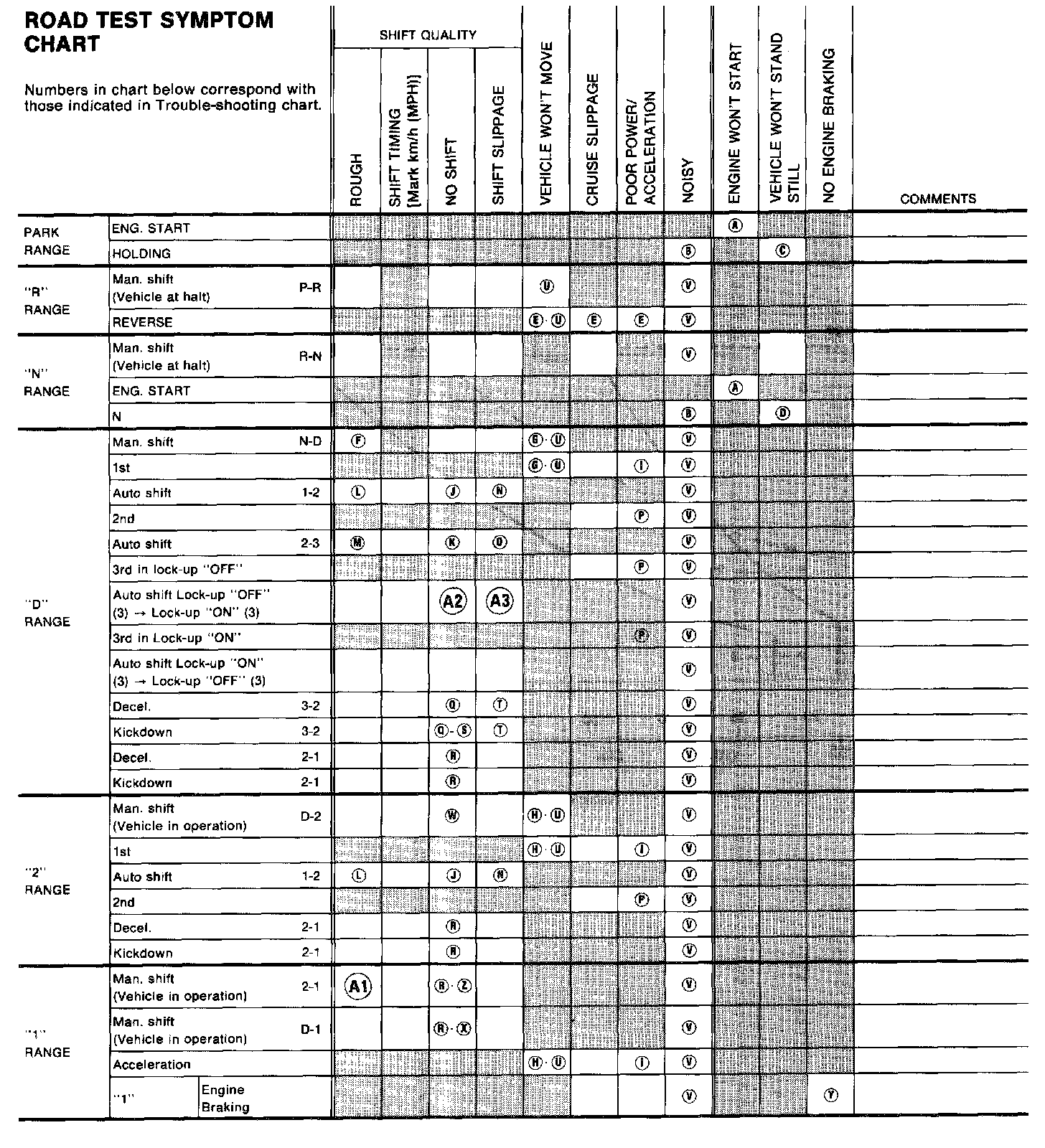
Road TestingPerform road tests using "Symptom" chart.
"P" RANGE
1. Place selector lever in "P" range and start engine. Stop engine and repeat the procedure in all ranges including neutral.
2. Stop vehicle on a slight upgrade and place selector lever in "P" range. Release parking brake to make sure vehicle remains locked.
"R" RANGE
1. Manually move selector lever from "P" to "R", and note shift quality.
2. Drive vehicle in reverse long enough to detect slippage or other abnormalities.
"N" RANGE
1. Manually move selector lever from "R" and "D" to "N" and note quality.
2. Release parking brake with selector lever in "N" range. Lightly depress accelerator pedal to make sure vehicle does not move. (When vehicle is new or soon after clutches have been replaced, vehicle may move slightly. This is not a problem.)
"D" RANGE
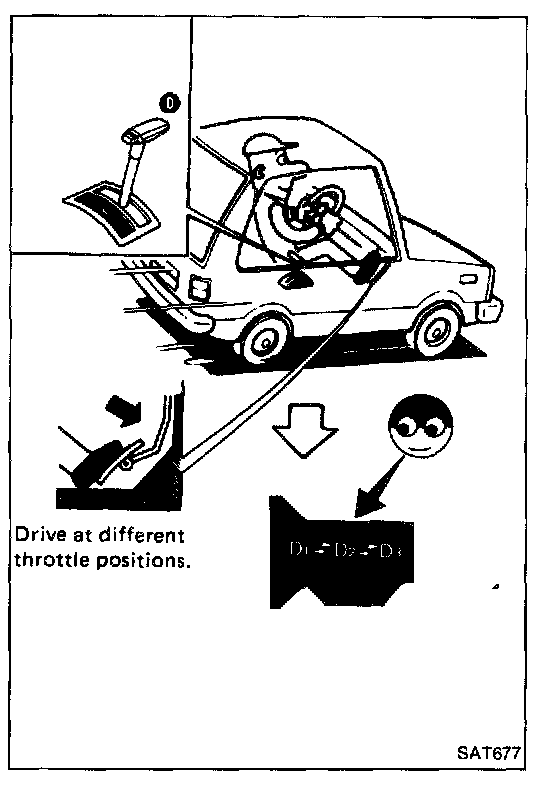
1. Manually shift selector lever from "N" to "D" range, and note shift quality.
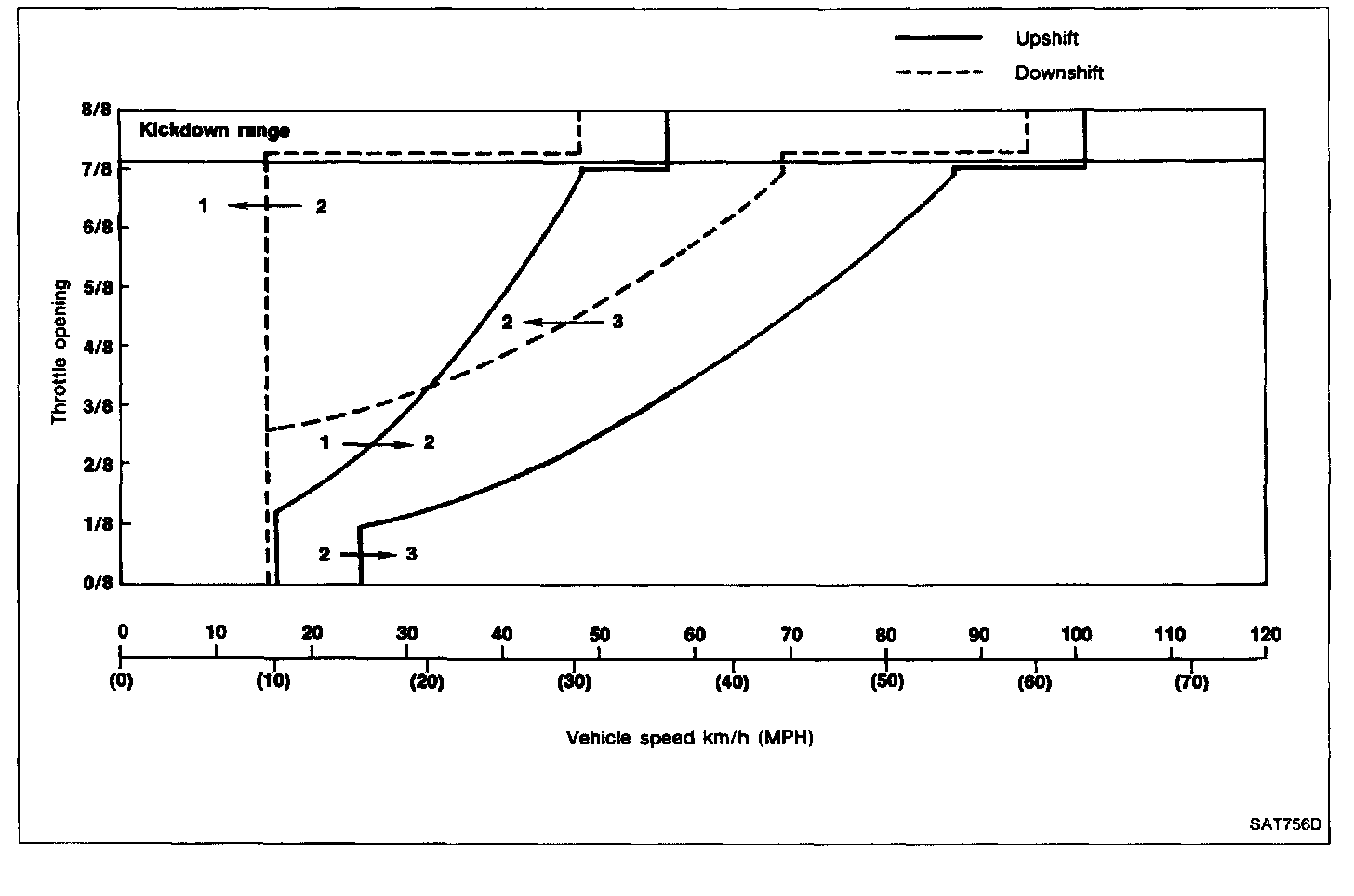
2. Using the shift schedule as a reference, drive vehicle in "D" range. Record, on symptom chart, respective vehicle speeds at which upshifting (1st -> 2nd and 2nd -> 3rd) and downshifting (3rd -> 2nd and 2nd -> 1st) occur. These speeds are to be read at three different throttle positions (light, half and full), respectively. Also determine the timing at which shocks are encountered during shifting and which clutches are engaged.
3. Determine whether lock-up properly occurs while driving vehicle at proper vehicle speed.
4. While driving vehicle in the 65 to 85 KPH (40 to 53 MPH) range in "D(3)" range at half to light throttle position, fully depress accelerator pedal to make sure transaxle down shifts from 3rd to 2nd gear.
5. While driving vehicle in the 25 to 35 KPH (16 to 22 MPH) ("D(2)" range) at half to light throttle position, fully depress accelerator pedal to make sure transaxle downshifts from 2nd to 1st gear.
"2" RANGE
1. Shift to "2" range and check to make sure that vehicle starts to move in 1st gear.
2. Increase vehicle speed to make sure transaxle upshifts from 1st to 2nd gear.
3. Further increase vehicle speed. Make sure transaxle does not upshift to 3rd gear.
4. While driving vehicle at the 25 to 35 KPH (16 to 22 MPH) with throttle at halt to light position ("2(2)" range), fully depress accelerator pedal to make sure transaxle downshifts from 2nd to 1st gear.
5. Allow vehicle to run idle while in 2nd gear to make sure that transaxle downshifts to 1st gear.
6. Move selector lever to "D" range and allow vehicle to operate at 40 to 50 KPH (25 to 31 MPH). Then, shift to "2" range to make sure transaxle downshifts to 2nd gear.
"1" RANGE
1. Place selector lever in "1" range and accelerate vehicle. Make sure transaxle does not upshift from 1st to 2nd gear although vehicle speed increases.
2. While driving vehicle in "1" range, release accelerator pedal to make sure that engine compression acts as a brake.
3. Place selector lever in "D" or "2" range and allow vehicle to run at 20 to 30 KPH (12 to 19 MPH). Then, move selector lever to "1" range to make sure transaxle downshifts to 1st gear.
VEHICLE SPEED WHEN SHIFTING GEARS
This check should be carried out when oil temperature is between 45 and 55°C (113 and 131°F) after vehicle has been driven approx. 10 minutes.
Shift Schedule:
Road Test Symptom Chart: