Steering Angle
Fig. 6 Turning Angle Specifications:
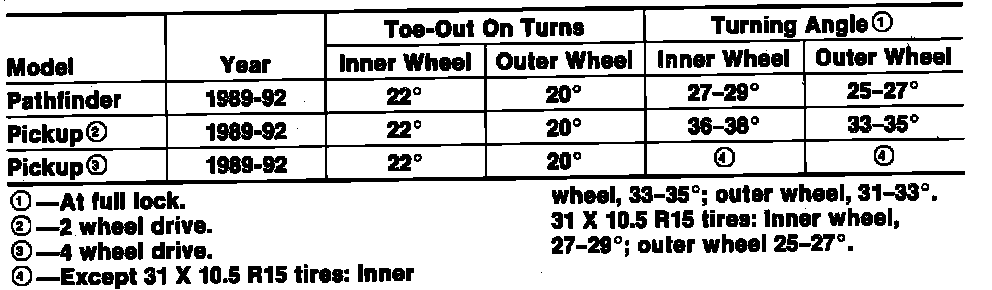
When a vehicle negotiates a turn, the inner wheel must turn at a sharper angle than the outer wheel, and the outer wheel must travel farther than the inner wheel. Vehicle steering geometry is calculated to allow for these variations, causing the outer wheel to toe-out by a calibrated amount. This toe-out on turns is also referred to as steering angle and on these models, is generally checked at two positions. The first position is at a reference point on the inner wheel travel while the second position of measurement is at full steering lock. To check steering angles, proceed as follows:
1. Place vehicle on suitable alignment rack and ensure kingpin angle, caster, camber and toe settings are within specifications.
2. Turn wheels from straight-ahead position until the inner wheel is at the position specified for ``Toe-Out On Turns'' shown in Fig. 6. If the outer wheel reference angle is incorrect, check for damaged or improperly adjusted tie rods. Perform check in both left and right directions.
3. On models less rack and pinion steering, proceed as follows:
a. Rotate steering to full lock in each direction.
b. Adjust inner wheel ``Turning Angle'' to value specified in Fig. 6, by adjusting position of steering stop.
c. With inner wheel adjusted to specifications, outer wheel turning angle should be as specified in Fig. 6. If outer wheel turning angle is incorrect, repair or replace steering linkage as needed.
4. On models with rack and pinion steering, proceed as follows:
a. Turn steering to full lock and measure inner and outer wheel turning angles.
b. If ``Turning Angles'' at full lock are not within specifications, Fig. 6, check for damaged steering linkage or improperly adjusted tie rods.
c. If steering linkage and tie rods are satisfactory, check for improper rack or rack piston stroke and repair steering gear as needed.