Step 2: Parking Brake Adjustment:
Step 2: Parking Brake Adjustment: - In order for the rear brakes to operate as designed, the clearances between the brake drum and the brake shoes must be kept within a narrow range.^ Too much clearance can result in poor braking, long stopping distances, excessive pedal travel or ineffective parking brake operation.
^ Too little clearance can cause early lockup on one or both sides, or brake pull due to uneven braking forces.
The automatic parking brake adjuster prevents too much clearance by compensating for brake shoe wear. The adjuster cannot compensate for too little clearance. Use the following procedure to make sure the clearances are in the proper range:
FIGURE 1:
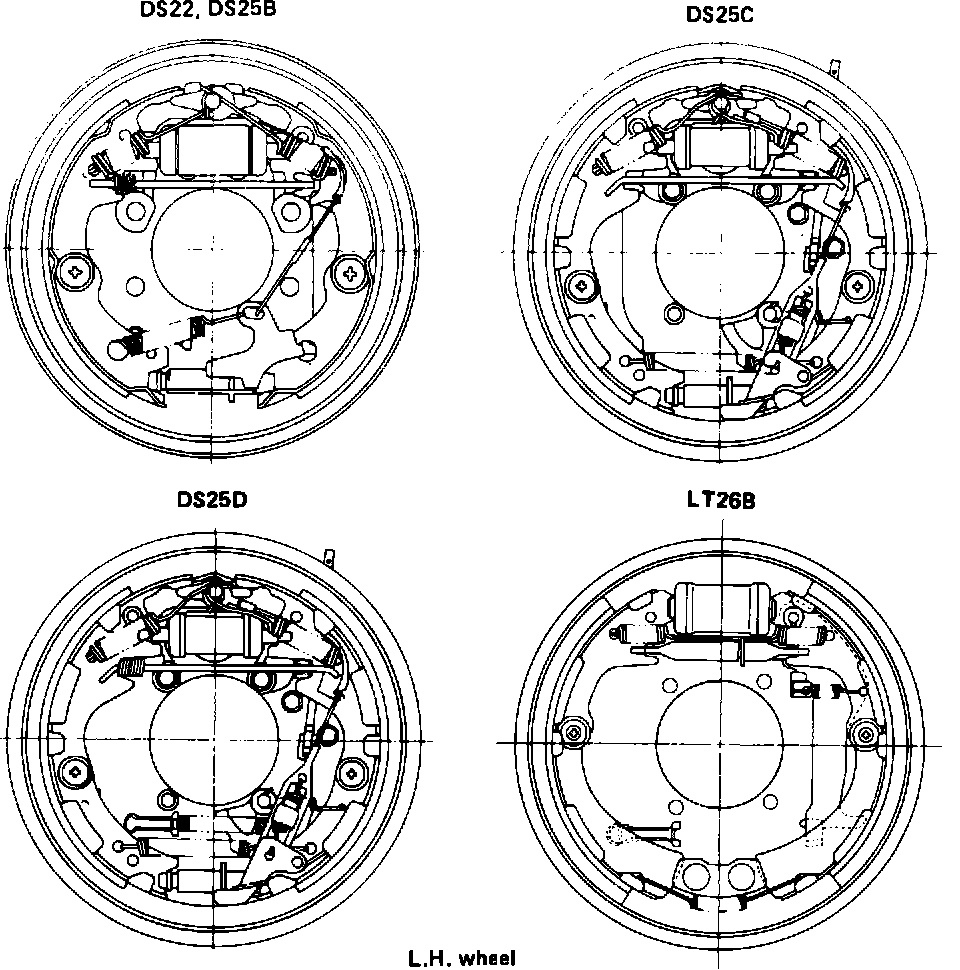
1. Remove both rear wheels and brake drums. Inspect the drum and shoe surfaces for good contact. Compare the brakes with those shown to determine which type of rear brake is on the vehicle (Figure 1).
FIGURE 2:
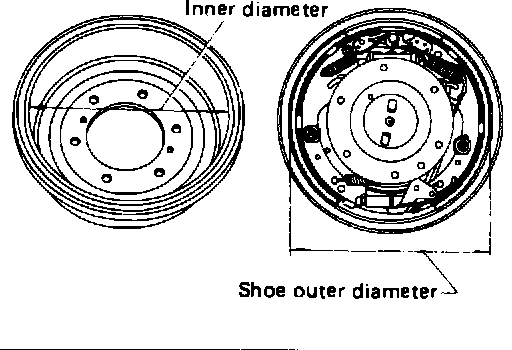
2. Measure the brake drum inside diameter and the brake shoe outer diameter at the center (Figure 2).
3. Rotate the star wheel on the adjuster until the brake shoe outer diameter is 0.25-0.4 mm smaller than the brake drum inside diameter.
4. Install the brake drums and wheels.
5. Use the automatic parking brake adjuster to make the final adjustment as follows:
^ For vehicles with LT26B rear brakes, apply and release the parking brake lever about 20 times.
^ For vehicles with DS22, DS25B, DS25C or DS25D rear brakes, apply the service brake about 15 times while driving in reverse.
6. Road test the vehicle. If brake pull still exists, proceed to step 3.