Shifting Mode
WARNING: This page is about a different variant/trim than selected.
By the operation of shift lever, the automatic mode and manual mode can be selected.
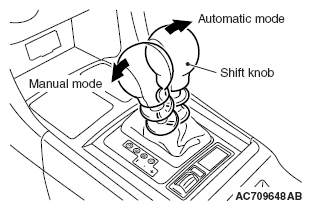 Courtesy of MITSUBISHI MOTOR SALES OF AMERICA.
 SHIFT LEVER OPERATION CHART
| Mode |
Control content |
Automatic mode
(Shift lever position: D) |
- Shifting is performed automatically according to the shift map. By the operation of paddle shift, the mode can be changed to the manual mode. (When the "+" side lever of paddle shift is pulled for 2 seconds, the mode returns to the automatic mode. When the vehicle is stopped, the mode automatically returns to the automatic mode.)
- In combination with the drive mode, it provides support for the economy driving to circuit driving.
|
Manual mode
(Shift lever position: +/- side) |
- By the operation of shift lever or paddle shift, the driver can change gears at any timing.
- No automatic shifting is performed during driving, but the selection of 1st gear and clutch engagement at starting are performed automatically. Also, the gear is downshifted automatically during deceleration before a stop, and the clutch is released during stop to achieve the neutral status.
NOTE:
- Depending on the driving and operation conditions, the shifting may be restricted, including the prohibition of upshifting to ensure the driving performance and prohibition of downshifting to prevent the engine over revolution.
- When the fluid temperature is high, the shifting may be delayed from the operation in order to protect the TC-SST assembly.
|