17 00 009 Checking cooling system for water leaks
WARNING: This page does not describe the selected car, but rather 11 other vehicles, including the 2008 BMW 328xi, 2008 BMW 328i, 2008 BMW 323i, 2007 BMW 328xi, and 2007 BMW 328i. However, it is still accessible from the selected car via links, so may be relevant.
Special tools required:
- 17 0 101
- 17 0 113
- 17 0 114
WARNING:
Danger of scalding!Only perform this work after engine has cooled down.
Checking pressure drop in cooling system:
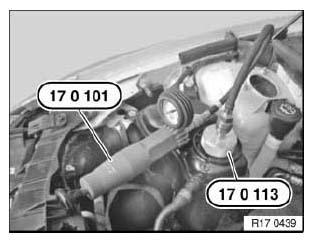
Open cap on coolant expansion tank. Fit special tools 17 0 101 / 17 0 113.
Build Up Gauge Pressure
, wait approx. 2 minutes.
Cooling system is impervious to leaks if pressure drop is max. 0.1 bar.
 Courtesy of BMW OF NORTH AMERICA, INC.
Checking pressure relief valve in cap:
NOTE:
While the vehicle is driven at high outside temperatures, the design may cause the pressure relief valve in the cap to open slightly and air together with dissolved coolant to escape. This coolant vapour condenses on the surface of the expansion tank and leaves traces when the vehicle has cooled down. These traces do not indicate whether the cap is defective or not. When the vehicle has been parked up for an extended period of time, the residual escaping coolant can cause the pressure relief valve in the cap to stick; therefore check the cap again 2 to 3 times.
Replace the cap only after you have checked three times and there is an incorrect opening pressure.
Checking pressure relief valve in cap:
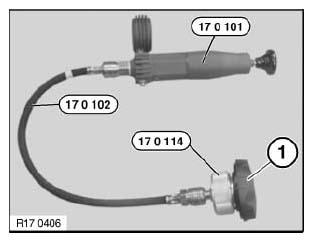
Screw cap (1) onto special tool 17 0 114.
Build up pressure with special tool (hand pump) 17 0 101; observe pressure gauge to ascertain when opening pressure is achieved.
Compare Opening Pressure Of Pressure Relief Valve
.
 Courtesy of BMW OF NORTH AMERICA, INC.
Special tools required:
- 17 0 101
- 17 0 113
- 17 0 114
WARNING:
Danger of scalding!Only perform this work after engine has cooled down.
Checking pressure drop in cooling system:
Open cap on coolant expansion tank. Fit special tools 17 0 101 / 17 0 113.
Build Up Gauge Pressure
, wait approx. 2 minutes.
Cooling system is impervious to leaks if pressure drop is max. 0.1 bar.
Courtesy of BMW OF NORTH AMERICA, INC.
Checking pressure relief valve in cap:
NOTE:
While the vehicle is driven at high outside temperatures, the design may cause the pressure relief valve in the cap to open slightly and air together with dissolved coolant to escape. This coolant vapour condenses on the surface of the expansion tank and leaves traces when the vehicle has cooled down. These traces do not indicate whether the cap is defective or not. When the vehicle has been parked up for an extended period of time, the residual escaping coolant can cause the pressure relief valve in the cap to stick; therefore check the cap again 2 to 3 times.
Replace the cap only after you have checked three times and there is an incorrect opening pressure.
Checking pressure relief valve in cap:
Screw cap (1) onto special tool 17 0 114.
Build up pressure with special tool (hand pump) 17 0 101; observe pressure gauge to ascertain when opening pressure is achieved.
Compare Opening Pressure Of Pressure Relief Valve
.
Courtesy of BMW OF NORTH AMERICA, INC.