Inspection and Verification: Notes
- Verify the customer concern.
- Visually inspect for obvious signs of mechanical or electrical damage.
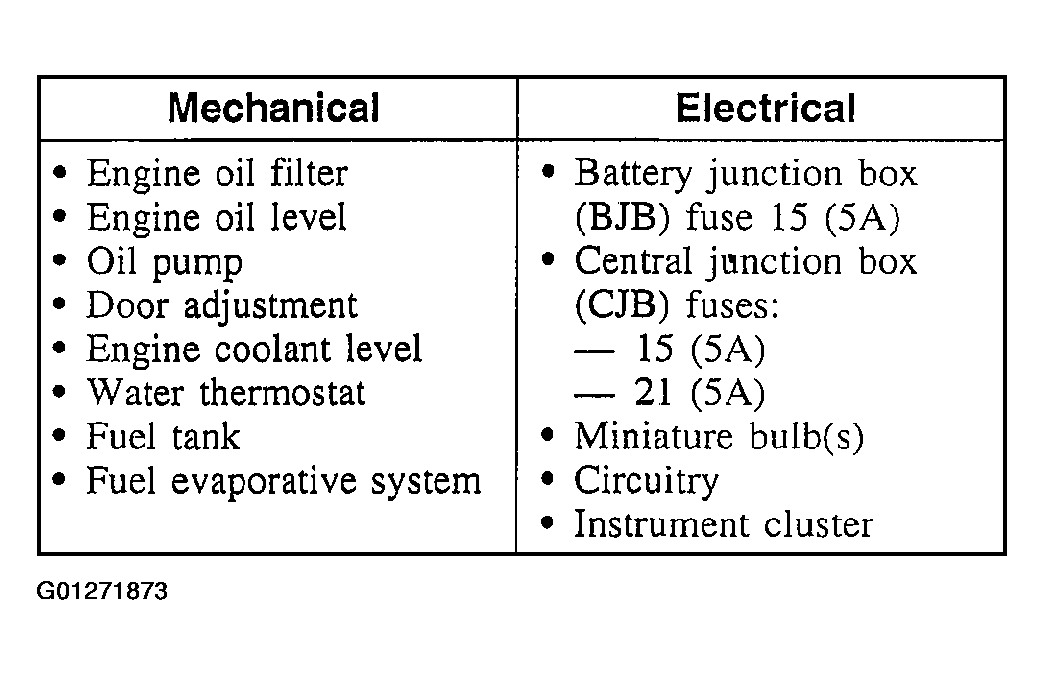 Courtesy of FORD MOTOR CO.
- If an obvious cause for an observed or reported concern is found, correct the cause (if possible) before proceeding to the next step.
- If the concern is not visually evident, connect the diagnostic tool to the data link connector and select the vehicle to be tested from the diagnostic tool menu. If the diagnostic tool does not communicate with the vehicle:
- check that the program card or disk is correctly installed.
- check the connections to the vehicle.
- check the ignition switch position.
- If the diagnostic tool still does not communicate with the vehicle, refer to the Diagnostic tool operating manual.
- Carry out the diagnostic tool data link test. If the diagnostic tool responds with:
- SCP+, SCP-, or UBP circuit fault; all electronic control units no response/not equipped, refer to
MODULE COMMUNICATIONS NETWORK
.
- No response/not equipped for the instrument cluster, GO to PINPOINT TEST G . For vehicle security module, refer to
MODULE COMMUNICATIONS NETWORK
, for anti-lock brake system (ABS), refer to
ANTI-LOCK CONTROL
; or for restraint control module, refer to
AIR BAG RESTRAINT SYSTEMS
.
- System passed, retrieve and record the continuous diagnostic trouble codes (DTCs), erase the continuous DTCs and carry out self-test diagnostics for the instrument cluster.
- If the DTCs retrieved are related to the concern, go to the Instrument Cluster Diagnostic Trouble Code (DTC) Index, or Powertrain Control Module (PCM) Diagnostic Trouble Code (DTC) Index to continue diagnostics. For all other DTCs, refer to
MODULE COMMUNICATIONS NETWORK
.
- If no DTCs related to the concern are retrieved, GO to SYMPTOM CHART to continue diagnostics.