Hard To Start/Long Crank/Erratic Start/Erratic Crank (Us): Notes
WARNING: This page is about a different car, the 2020 Mazda CX-30. However, it is still accessible from the selected car via links, so may be relevant.
HARD TO START/LONG CRANK/ERRATIC START/ERRATIC CRANK (SKYACTIV-G, US) DESCRIPTION AND POSSIBLE CAUSE
| Troubleshooting item |
Hard to start/Long crank/Erratic start/Erratic crank |
| Description |
- Starter cranks engine at normal speed but engine requires excessive cranking time before starting.
- Battery is operating normally.
|
| Possible cause |
NOTE:
- If the ignition is not switched off or ACC after the engine stalls, and then an engine restart is attempted, the PCM corrects the difference between CKP sensor and CMP sensor signals caused by engine stalling, which may result in more time needed to restart the engine.
- Engine overheating
- PCM DTC is stored
- Erratic signal to PCM
- ECT sensor No. 1 or related circuit malfunction
- ECT sensor No. 2 or related circuit malfunction
- MAF sensor or related circuit malfunction
- MAP sensor or related circuit malfunction
- A/F sensor or related circuit malfunction
- HO2S or related circuit malfunction
- Improper operation of drive-by-wire control system
- Incorrect fuel injection timing
- Fuel injector malfunction
- Purge solenoid valve malfunction
- Contamination in MAF sensor
- Under the condition in which the engine starts and stops repeatedly while the vehicle is not driven, the fuel injected prior to complete ignition during engine start may drop into the oil pan from the cylinder and mix with the engine oil. The situation in which excess quantities of fuel continue to be injected due to an engine coolant temperature signal error is the same.
- Intermittent open circuit in PCM ground circuit
- Poor fuel quality
- Fuel leakage
- Air leakage from intake-air system
- Intake-air system restriction
- Vacuum leakage
- Improper engine oil viscosity
- Erratic signal from CKP sensor
- Loose installation
- Damaged trigger wheel (crankshaft pulley)
- Open or short circuit in related wiring harness
- Erratic signal from CMP sensor
- Loose installation
- Damaged trigger wheel (intake camshaft and/or exhaust camshaft)
- Open or short circuit in related wiring harness
- Inadequate fuel pressure (high or low pressure side)
- Fuel pressure sensor or related circuit malfunction
- High pressure fuel pump malfunction
- Spill valve control solenoid valve control circuit malfunction (damage to driver in PCM caused by short circuit to ground system)
- Spill valve control solenoid valve malfunction (built-into high pressure fuel pump)
- Relief valve (built-into high pressure fuel pump) malfunction
- Fuel line restriction
- Fuel filter clogged
- Fuel pump unit malfunction
- Starting system malfunction
- Low engine compression
- Improper intake valve timing
- Improper exhaust valve timing
- Improper operation of electric variable valve timing control system
- Electric variable valve timing driver malfunction
- Electric variable valve timing motor malfunction
- Electric variable valve timing actuator malfunction
- Improper operation of hydraulic variable valve timing control system
- Ignition coil malfunction
- Spark plug malfunction
- Exhaust system and/or TWC restriction
- PCV valve malfunction
- Injector driver (built-into PCM) malfunction
|
| Possible cause |
WARNING:
- The following troubleshooting flow chart contains the fuel system diagnosis and repair procedures. Read the following warnings before performing the fuel system services:
- Fuel may cause irritation if it comes in contact with skin and eyes.
- If fuel ignites and causes a fire, it may lead to serious injury or death, and damage to property and facilities.
CAUTION:
- Disconnecting/connecting the quick release connector without cleaning it may possibly cause damage to the fuel pipe and quick release connector. Always clean the quick release connector joint area before disconnecting/connecting, and make sure that it is free of foreign material.
|
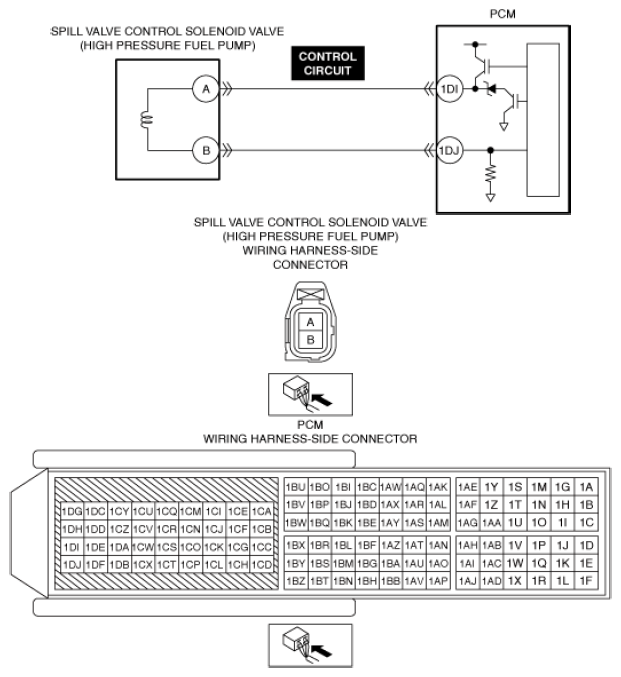 Courtesy of MAZDA MOTORS CORP. Courtesy of MAZDA MOTORS CORP.
|
CAUTION:
- Verify the malfunction symptom according to not only the PID value but also the symptom troubleshooting.