Noise, Vibration and Harshness (NVH)-Acceptable Noise-Tools and Techniques
NOISE, VIBRATION AND HARSHNESS (NVH)Noise is any undesirable sound, usually unpleasant in nature. Vibration is any motion, shaking or trembling, that can be felt or seen when an object moves back and forth or up and down. Harshness is a ride quality issue where the vehicle's response to the road transmits sharply to the customer. Harshness normally describes a firmer than usual response from the suspension system. Noise, vibration and harshness (NVH) is a term used to describe these conditions, which result in varying degrees of dissatisfaction. Although, a certain level of NVH caused by road and environmental conditions is normal. This section is designed to aid in the diagnosis, testing and repair of NVH concerns.
Acceptable Noise, Vibration and Harshness
All internal combustion engines and drivelines produce some noise and vibration; operating in a real world environment adds noise that is not subject to control. Vibration isolators, mufflers and dampers reduce these to acceptable levels. A driver who is unfamiliar with a vehicle can think that some sounds are abnormal when actually the sounds are normal for the vehicle type. For example, Traction-Lok differentials produce a slight noise on slow turns after extended highway driving. This is acceptable and has no detrimental effect on the locking axle function. As a technician, it is very important to be familiar with vehicle features and know how they relate to NVH concerns and their diagnosis. For example, if the vehicle has automatic overdrive, it is important to test drive the vehicle both in and out of overdrive mode.
Diagnostic Theory
The shortest route to an accurate diagnosis results from:
^ system knowledge, including comparison with a known good system.
^ system history, including repair history and usage patterns.
^ condition history, especially any relationship to repairs or sudden change.
^ knowledge of possible sources.
^ using a systematic diagnostic method that divides the system into related areas.
The diagnosis and correction of NVH concerns requires: a road or system test to determine the exact nature of the concern. an analysis of the possible causes. testing to verify the cause. repairing any concerns found. a road test or system test to make sure the concern has been corrected or brought back to within an acceptable range.
Glossary of Terms
Acceleration-Light
An increase in speed at less than half throttle.
Acceleration-Medium
An increase in speed at half to nearly full throttle, such as 0 - 97 km/h (0 - 60 mph) in approximately 30 seconds.
Acceleration-Heavy
An increase in speed at one-half to full throttle, such as 0 - 97 km/h (0 - 60 mph) in approximately 20 seconds.
Active Torque Coupling
This part is attached to the rear differential on 4WD vehicles. It has an internal electromagnetic clutch to lock the active torque coupling for the 4WD system. This unit is not to be disassembled and if necessary a new unit must be installed. The active torque coupling and rear differential are installed as an assembly.
Ambient Temperature
The surrounding or prevailing temperature.
Amplitude
The quantity or amount of energy produced by a vibrating component (G force). An extreme vibration has a high amplitude. A mild vibration has a low amplitude.
Backlash
Gear teeth clearance.
Boom
Low frequency or low pitched noise often accompanied by a vibration. Also referred to as drumming.
Bound Up
An overstressed isolation (rubber) mount that transmits vibration/noise instead of absorbing it.
Brakes Applied
When the service brakes are applied with enough force to hold the vehicle against movement with the transaxle in gear.
Buffet/Buffeting
Strong noise fluctuations (less than 1,000 Hz) caused by gusting winds, An example would be wind gusts against the side glass.
Buzz
A low-pitched sound like (200 - 5,000 Hz) that from a bee. Often a metallic or hard plastic humming sound. Also describes a high frequency (200 - 800 Hz) vibration. Vibration feels similar to an electric razor.
Camber
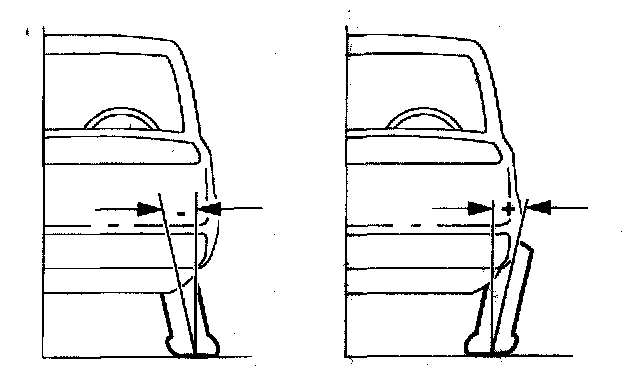
The angle of the wheel in relation to the true vertical as measured looking from the front of the vehicle. Camber is positive when the wheel angle is offset so that the top of the wheel is positioned away from the vehicle.
Caster
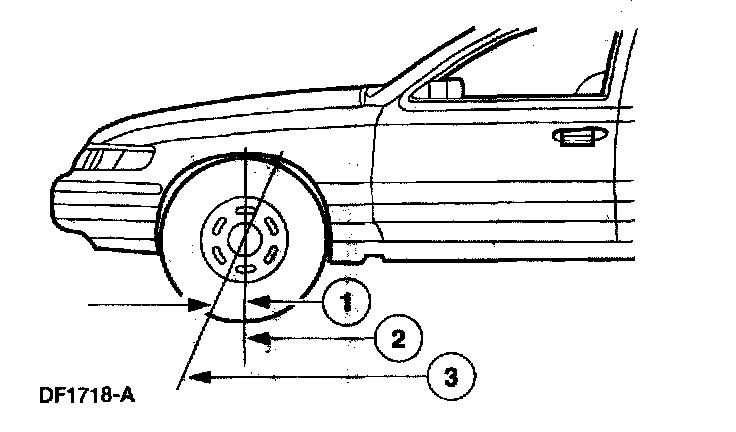

The angle of the steering knuckle in relation to the true vertical as measured looking from the side of the vehicle.
Chatter
A pronounced series of rapidly repeating rattling or clicking sounds.
Chirp
A short-duration high-pitched noise associated with a slipping drive belt.
Chuckle
A repetitious low-pitched sound. A loud chuckle is usually described as a knock.
Click
A sharp, brief, non-resonant sound, similar to actuating a ball point pen.
Clonk
A hydraulic knocking sound. Sound occurs with air pockets in a hydraulic system. Also described as hammering.
Clunk/Driveline Clunk
A heavy or dull, short-duration, low-frequency sound. Occurs mostly on a vehicle that is accelerating or decelerating abruptly. Also described as a thunk.
Coast/Deceleration
Releasing the accelerator pedal at cruise, allowing the engine to reduce vehicle speed without applying the brakes.
Coast/Neutral Coast
Placing the transaxle range selector in NEUTRAL (N) or pressing the clutch pedal while at cruise.
Constant Velocity (CV) Joint
A joint used to absorb vibrations caused by driving power being transmitted at an angle.
Controlled Rear Suspension Height
The height at which a designated vehicle element must be when driveline angle measurements are made.
Coupling Shaft
The shaft between the transfer case and the front drive axle or, in a two-piece rear driveshaft, the front section.
CPS
Cycles per second. Same as hertz (Hz).
Cracks
A mid-frequency sound, related to squeak. Sound varies with temperature conditions.
Creak
A metallic squeak.
Cruise
Constant speed on level ground; neither accelerating nor decelerating.
Cycle
The process of a vibrating component going through a complete range of motion and returning to the starting point.
Decibel
l A unit of measurement, referring to sound pressure level, abbreviated dB.
Drive Engine Run-Up (DERU) Test
The operation of the engine through the normal rpm range with the vehicle standing still, the brakes applied and the transaxle engaged. This test is used for noise and vibration checks.
Driveline Angles
The differences of alignment between the transaxle output shaft, the driveshaft, and the rear axle pinion centerline.
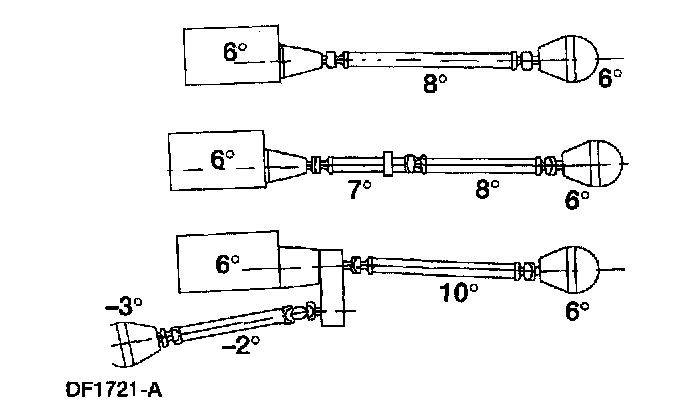
Driveshaft
The shaft that transmits power to the rear axle input shaft (pinion shaft). In a two-piece driveshaft, it is the rearmost shaft. Drivetrain All power transmitting components from the engine to the wheels; includes the clutch or torque converter, the transaxle, the transfer case, the driveshaft, and the front or rear drive axle.
Drivetrain Damper
A weight attached to the engine, the transaxle, the transfer case, or the axle. It is tuned by weight and placement to absorb vibration.
Drone
A low frequency (100 - 200 Hz) steady sound, like a freezer compressor. Also described as a moan.
Drumming
A cycling, low-frequency (20 - 100 Hz), rhythmic noise often accompanied by a sensation of pressure on the ear drums. Also described as a low rumble, boom, or rolling thunder.
Dynamic Balance
The equal distribution of weight on each side of the centerline, so that when the wheel and tire assembly spins, there is no tendency for the assembly to move from side-to-side (wobble). Dynamically unbalanced wheel and tire assemblies can cause wheel shimmy.
Engine Imbalance
A condition in which an engine's center mass is not concentric to the rotation center, causing excessive motion.
Engine Misfire
When combustion in one or more cylinders does not occur or occurs at the wrong time.
Engine Shake
An exaggerated engine movement or vibration that directly increases in frequency as the engine speed increases. It is caused by non-equal distribution of mass in the rotating or reciprocating components.
Flexible Coupling
A flexible joint.
Float
A drive mode on the dividing line between cruise and coast where the throttle setting matches the engine speed with the road speed.
Flutter
Mid to high (100 - 2000 Hz) intermittent sound due to air flow. Similar to a flag flapping in the wind.
Frequency
The rate at which a cycle occurs within a given time.
Gravelly Feel
A grinding or growl in a component, similar to the feel experienced when driving on gravel.
Grind
An abrasive sound, similar to using a grinding wheel, or rubbing sand paper against wood.
Hiss
Steady high frequency (200 - 800 Hz) noise. Vacuum leak sound.
Hoot
A steady low frequency tone (50 - 500 Hz), sounds like blowing over a long neck bottle.
Howl
A mid-range frequency (200 - 800 Hz) noise between drumming and whine. Also described as a hum.
Hum
Mid-frequency (200 - 800 Hz) steady sound, like a small fan motor. Also described as a howl.
Hz
Hertz; a frequency measured in cycles per second.
Imbalance
Out of balance; heavier on one side than the other. In a rotating component, imbalance often causes vibration.
Inboard
Toward the centerline of the vehicle.
Intensity
The physical quality of sound that relates to the strength of the vibration (measured in decibels). The higher the sound's amplitude, the higher the intensity and vice versa.
Isolate
To separate the influence of one component to another.
Knock
A heavy, loud, repetitious sound, like a knock on the door.
Moan
A constant, low-frequency (100 - 200 Hz) tone. Also described as a hum.
Neutral Engine Run-Up (NERU) Test
The operation of the engine through the normal rpm range with the vehicle standing still and the transaxle disengaged. This test is used to identify engine related vibrations.
Neutralize/Normalize
To return to an unstressed position. Used to describe mounts. See Bound Up.
Outboard
Away from the centerline of the vehicle.
Ping
A short duration, high-frequency sound, which has a slight echo.
Pinion Shaft
The input shaft in a driving axle that is usually a part of the smaller driving or input hypoid gear of a ring and pinion gearset.
Pitch
The physical quality of sound that relates to its frequency. Pitch increases as frequency increases and vice versa.
Pumping Feel
A slow, pulsing movement.
Radial/Lateral
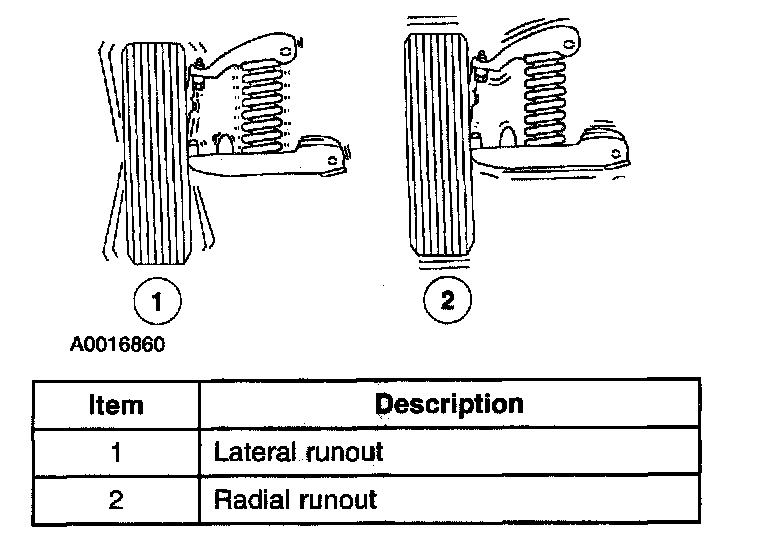
Radial is in the plane of rotation; lateral is at 90° to the plane of rotation.
Rattle
A random and momentary or short duration noise.
Ring Gear
The large, circular, driven gear in a ring and pinion gearset.
Road Test
The operation of the vehicle under conditions intended to produce the concern under investigation.
Roughness
A medium-frequency vibration. A slightly higher frequency (20 to 50 Hz) than a shake. This type of vibration is usually related to drivetrain components.
Runout
Lateral runout means measuring the movement or "wobble" of a wheel or tire at the sidewall. Radial runout means measuring the out-of-round at the tread surface.
Rustling
Intermittent sound of varying frequency (100 - 2000 Hz), sounds similar to shuffling through leaves.
Shake
A low-frequency vibration (5 - 20 Hz), usually with visible component movement. Usually relates to tires, wheels, brake drums or brake discs if it is vehicle speed sensitive, or engine if it is engine speed sensitive. Also referred to as a shimmy or wobble.
Shimmy
An abnormal vibration or wobbling, felt as a side-to-side motion of the steering wheel in the driveshaft rotation. Also described as waddle.
Shudder
A low-frequency vibration that is felt through the steering wheel or seat during light brake application.
Slap
A resonance from flat surfaces, such as safety belt webbing or door trim panels.
Slip Yoke/Slip Spline
The driveshaft coupling that allows length changes to occur while the suspension articulates and while the driveshaft rotates.
Squeak
A high-pitched transient sound, similar to rubbing fingers against a clean window.
Squeal
A long-duration, high-pitched noise.
Static Balance
The equal distribution of weight around the wheel. Statically unbalanced wheel and tire assemblies can cause a bouncing action called wheel tramp. This condition will eventually cause uneven tire wear.
Tap
A light, rhythmic, or intermittent hammering sound, similar to tapping a pencil on a table edge.
Thump
A dull beat caused by two items striking together.
Tick
A rhythmic tap, similar to a clock noise.
Tip-in Moan
A light moaning noise heard during light vehicle acceleration, usually between 40 - 100 km/h (25 - 62 mph).
TIR
Total indicated runout.
Tire Deflection
The change in tire diameter in the area where the tire contacts the ground.
Tire Flat Spots
A condition commonly caused by letting the vehicle stand while the tires cool off. This condition can be corrected by driving the vehicle until the tires are warm. Also, irregular tire wear patterns in the tire tread resulting from wheel-locked skids.
Tire Force Vibration
A tire vibration caused by variations in the construction of the tire that is noticeable when the tire rotates against the pavement. This condition can be present on perfectly round tires because of variations in the inner tire construction. This condition can occur at wheel rotation frequency or twice rotation frequency.
Transient
A noise or vibration that is momentary, a short duration.
Two-Plane Balance
Radial and lateral balance.
Vibration
Any motion, shaking or trembling, that can be felt or seen when an object moves back and forth or up and down.
Whine
A constant, high-pitched noise. Also described as a screech. Whistle High-pitched noise (above 500 Hz) with a very narrow frequency band. Examples of whistle noises are a turbocharger or airflow around an antenna.
Wind Noise
Any noise caused by air movement in, out or around the vehicle.
WOT
Wide open throttle.
Tools and Techniques
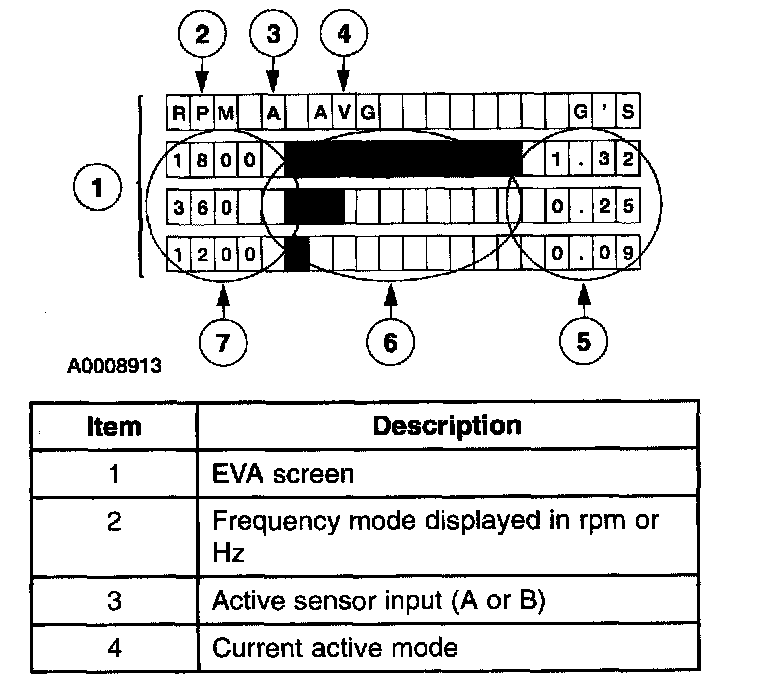
Electronic Vibration Analyzer (EVA)
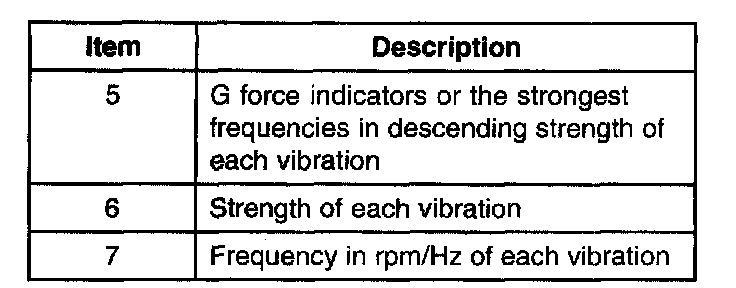
The EVA is a hand-held electronic tester which will assist in locating the source of unacceptable vibrations. The vibration sensor can be remotely mounted anywhere in the vehicle for testing purposes. The unit displays the 3 most common vibration frequencies and their corresponding amplitudes simultaneously. A bar graph provides a visual reference of the relative signal strength (amplitude) of each vibration being displayed and its relative G force. The keypad is arranged to make the EVA simple to program and use. Some of the functions include the ability to average readings as well as record, play back and freeze readings. The EVA has a strobe balancing function that can be used to detect imbalance on rotating components such as a driveshaft or engine accessories.
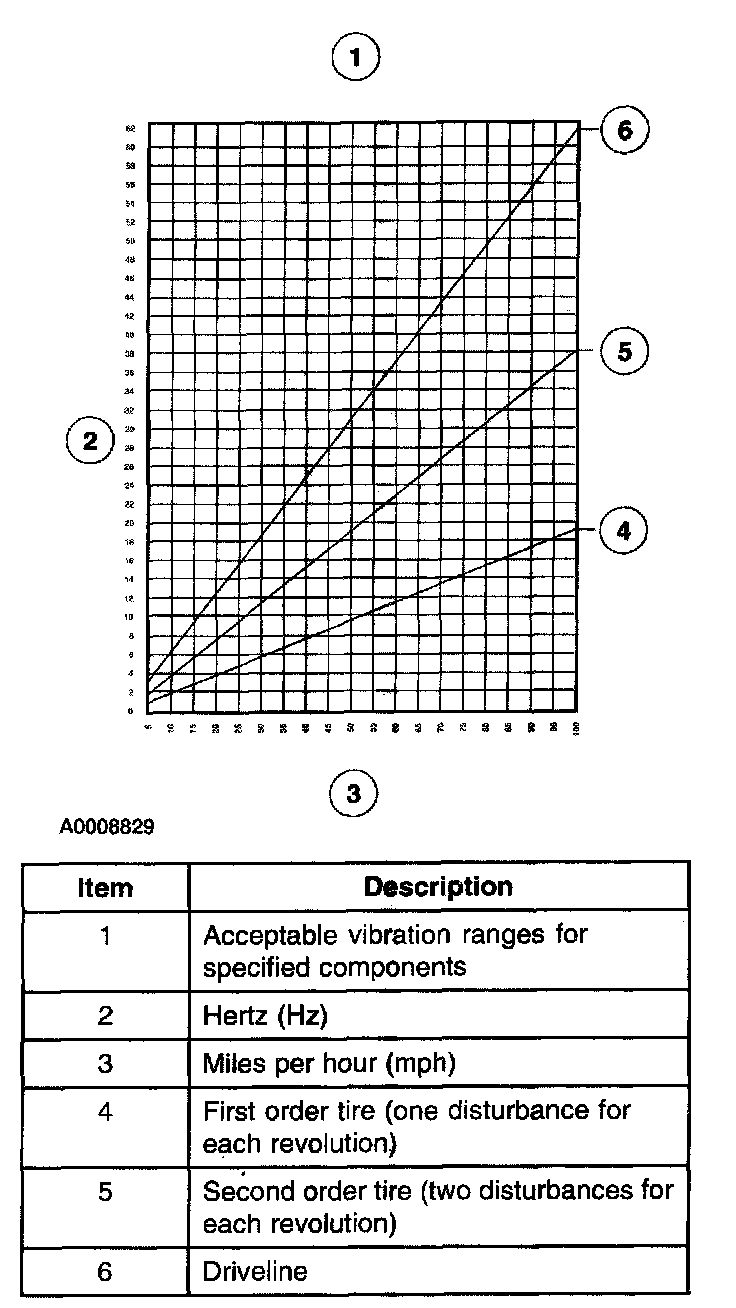
The EVA allows for a systematic collection of information that is necessary to accurately diagnose and repair NVH problems. For the best results, carry out the test as follows:
a. Test drive the vehicle with the vibration sensor inside the vehicle.
b. Place the sensor in the vehicle according to feel.
^ If the condition is felt through the steering wheel, the source is most likely in the front of the vehicle.
^ A vibration that is felt in the seat or floor only will most likely be found in the driveline, drive axle or rear wheels and tires.
c. Record the readings. Also note when the condition begins, when it reaches maximum intensity, and if it tends to diminish above/below a certain speed.
^ Frequencies should be read in the "average" mode.
^ Frequencies have a range of plus or minus 2. A reading of 10 Hz can be displayed as an 8 Hz through 12 Hz.
d. Determine what the normal frequency is for the vehicle at a specified speed. Multiply the rear axle ratio by the Hz (1 Hz per every 5 mph). Example: A vehicle traveling 50 mph with a 3.08 rear axle ratio, the acceptable amount of Hz for the vehicle at that speed would be 10 (1 Hz per every 5 mph) X 3.08 (rear axle ratio) = 30.8 Hz.
e. Place the vibration sensor on or near the suspect area outside the vehicle.
f. Continue the road test, driving the vehicle at the speed the symptom occurs, and take another reading.
g. Compare the readings.
^ A match in frequency indicates the problem component or area.
^ An unmatched test could indicate the concern is caused by the engine, torque converter, or engine accessory. Use the EVA in the rpm mode and check if concern is rpm related.
^ Example: A vibration is felt in the seat. Place the sensor on the console. Record the readings. Place the vibration sensor on the rear axle. Compare the readings. If the frequencies are the same, the axle is the problem component.
Vibrate Software
Vibrate Software is a diagnostic aid which will assist in pinpointing the source of unacceptable vibrations. The engine's crankshaft is the point of reference for vibration diagnosis. Every rotating component will have an angular velocity that is faster, slower, or the same as the engine's crankshaft. Vibrate Software@ calculates the angular velocity of each component and graphically represents these velocities on a computer screen and on a printed vibration worksheet. The following steps outline how Vibrate Software@ helps diagnose a vibration concern:
^ Enter the vehicle information. Vibrate will do all the calculations and display a graph showing tire, driveshaft and engine vibrations.
^ Print a Vibration Worksheet graph. The printed graph is to be used during the road test.
^ Road test the vehicle at the speed where the vibration is most noticeable. Record the vibration frequency (rpm) and the engine rpm on the worksheet graph. The point on the graph where the vibration frequency (rpm) reading and the engine rpm reading intersect indicates the specific component group causing the concern.
^ An EVA or equivalent tool capable of measuring vibration frequency and engine rpm will be needed.
^ Provide pictures of diagnostic procedures to aid in testing components.
Combination Engine EAR/Chassis EAR
An electronic listening device used to quickly identify noise and the location under the chassis while the vehicle is being road tested. The Chassis EARs can identify the noise and location of damaged/worn wheel bearings, CV joints, brakes, springs, axle bearings or driveshaft carrier bearings.
Engine EAR Basic Unit
An electronic listening device used to detect even the faintest noises. The Engine EARs can detect the noise of damaged/worn bearings in generators, water pumps, A/C compressors and power steering pumps. They are also used to identify noisy lifters, exhaust manifold leaks, chipped gear teeth and for detecting wind noise. The Engine EAR has a sensing tip, amplifier, and headphones. The directional sensing tip is used to listen to the various components. Point the sensing tip at the suspect component and adjust the volume with the amplifier. Placing the tip in direct contact with a component will reveal structure-borne noise and vibrations, generated by or passing through, the component. Various volume levels can reveal different sounds.
Ultrasonic Leak Detector
The ultrasonic leak detector is used to detect wind noises caused by leaks and gaps in areas where there is weather-stripping or other sealing material. It is also used to identify A/C leaks, vacuum leaks and evaporative emission noises. The ultrasonic leak detector includes a multi-directional transmitter (operating in the ultrasonic range) and a hand-held detector. The transmitter is placed inside the vehicle. On the outside of the vehicle, the hand-held detector is used to sweep the area of the suspected leak. As the source of the leak is approached, a beeping sound is produced which increases in both speed and frequency.
Squeak and Rattle Repair Kit
The squeak and rattle repair kit contains lubricants and self-adhesive materials that can be used to eliminate interior and exterior squeaks and rattles. The kit consists of the following materials:
^ PVC (soft foam) tape
^ Urethane (hard foam) tape
^ Flocked (black fuzzy) tape
^ UHMW (frosted) tape
^ Squeak and rattle oil tube
^ Squeak and rattle grease tube
Tracing Powder
Tracing powder is used to check both the uniformity of contact and the tension of a seal against its sealing surface. These tests are usually done when a suspected air leak/noise appears to originate from the seal area or during the alignment and adjustment of a component to a weatherstrip. Tracing powder can be ordered from Crest Industries as ATR Leak Trace. Carry out the tracing powder test as follows:
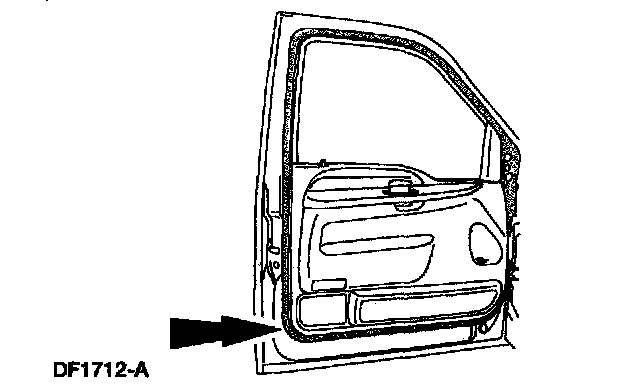
a. Clean the weatherstrip.
b. Spray the tracing powder on the mating surface only.
c. Close the door completely. Do not slam the door.
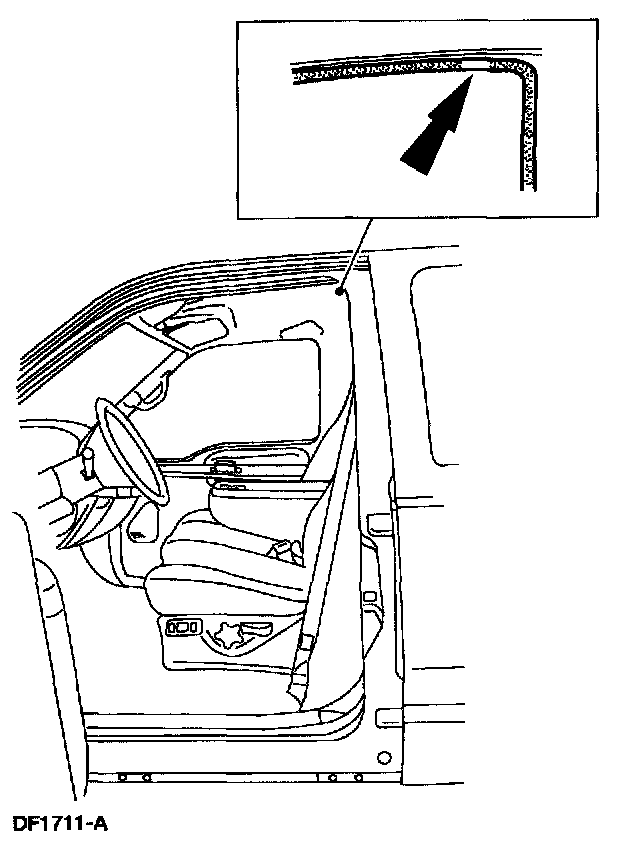
d. Open the door. An imprint is made where the weatherstrip contacted the mating surface seal. Gaps or a faint imprint will show where there is poor contact with the weatherstrip.
Index Card
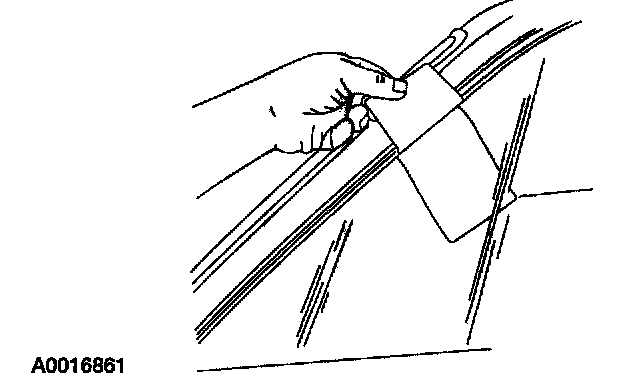
Place an index card or a piece of paper between the weatherstrip and the sealing surface, then close the door. Slowly withdraw the index card or paper after the door is closed and check the amount of pressure on the weatherstrip. There should be a medium amount of resistance as it is withdrawn. Continue around the entire seal area. If there is little or no resistance, this indicates insufficient contact to form a good seal. At these points, the door, the glass, or the weatherstrip is out of alignment.