Side Curtain Airbag
Fig. 45 SRS Logo:
SIDE CURTAIN AIRBAG
Optional side curtain airbags are available for this model when it is also equipped with dual front airbags. These airbags are passive, inflatable, Supplemental Restraint System (SRS) components, and vehicles with this equipment can be readily identified by a molded identification trim button with the "SRS - AIRBAG" logo located on the headliner above each B-pillar. This system is designed to reduce injuries to the vehicle occupants in the event of a side impact collision.
Fig. 46 Side Curtain Airbag:
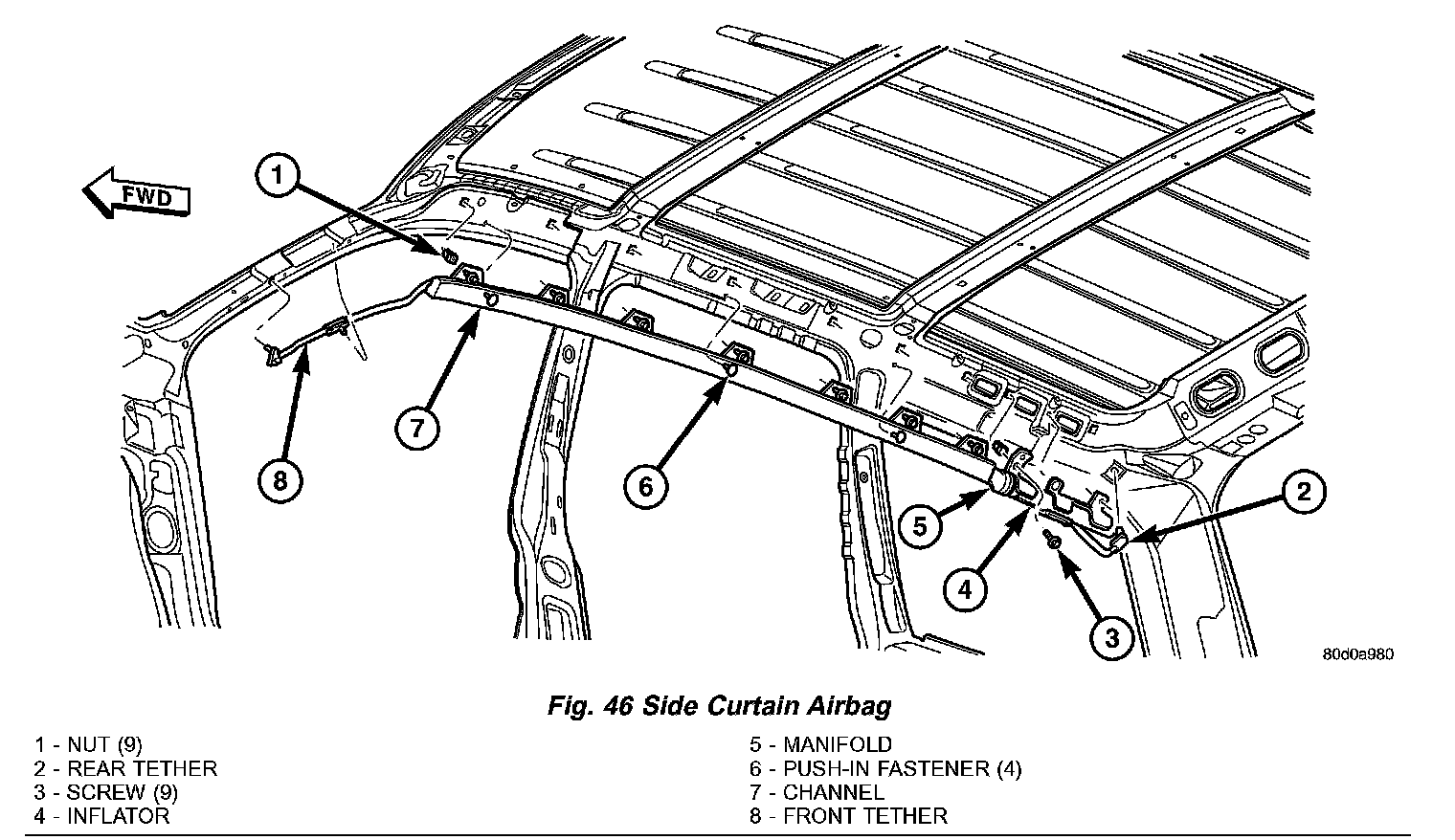
Vehicles equipped with side curtain airbags have two individually controlled curtain airbag units. These airbag units are concealed and mounted above the headliner where they are each secured to one of the roof side rails. Each folded airbag cushion is contained within a long extruded plastic channel that extends along the roof rail from the A-pillar at the front of the vehicle to just behind the C-pillar at the rear of the vehicle. One tether extends down the A-pillar from the front of the airbag cushion, and a second tether extends to the roof rail above the D-pillar. The ends of these tethers are secured to slots in the sheet metal with metal hooks retained by plastic anchor clips.
The hybrid-type inflator for each airbag is secured to the roof rail at the rear of the airbag unit between the C-pillar and the D-pillar, and is connected to the airbag cushion by a long tubular manifold. The inflator bracket and the extruded airbag cushion channel are secured with both plastic push-in fasteners and screws to the roof rail. A short pigtail wire and connector connect the airbag inflator to a dedicated take out and connector of the body wire harness near the top of the D-pillar.
The side curtain airbag unit cannot be adjusted or repaired and must be replaced if deployed, faulty, or in any way damaged. Once a side curtain airbag has been deployed, the complete airbag unit, the headliner, the upper A, B, and C-pillar trim, and all other visibly damaged components must be replaced.
Each side curtain airbag is deployed individually by an electrical signal generated by the Airbag Control Module (ACM) to which it is connected through left or right curtain airbag line 1 and line 2 (or squib) circuits. The hybrid-type inflator assembly for each airbag contains a small canister of highly compressed inert gas. When the ACM sends the proper electrical signal to the airbag inflator, the electrical energy creates enough heat to ignite chemical pellets within the inflator. Once ignited, these chemicals burn rapidly and produce the pressure necessary to rupture a containment disk in the inert gas canister. The inflator and inert gas canister are sealed and connected to a tubular manifold so that all of the released gas is directed into the folded side curtain airbag cushion, causing the cushion to inflate.
As the airbag cushion inflates it will drop down from the roof rail between the edge of the headliner and the side glass/body pillars to form a curtain-like cushion to protect the vehicle occupants during a side impact collision. The front and rear tethers keep the side curtain bag taut, thus ensuring that the bag will deploy in the proper position. Following the airbag deployment, the airbag cushion quickly deflates by venting the inert gas through the loose weave of the cushion fabric, and the deflated cushion hangs down loosely from the roof rail.