Front Disc Brakes
DESCRIPTION - FRONT DISC BRAKE PADSThe calipers are twin piston type. The calipers are free to slide laterally on the anchor, this allows continuous compensation for lining wear.
OPERATION - FRONT DISC BRAKE PADS
Disc Brake Caliper:
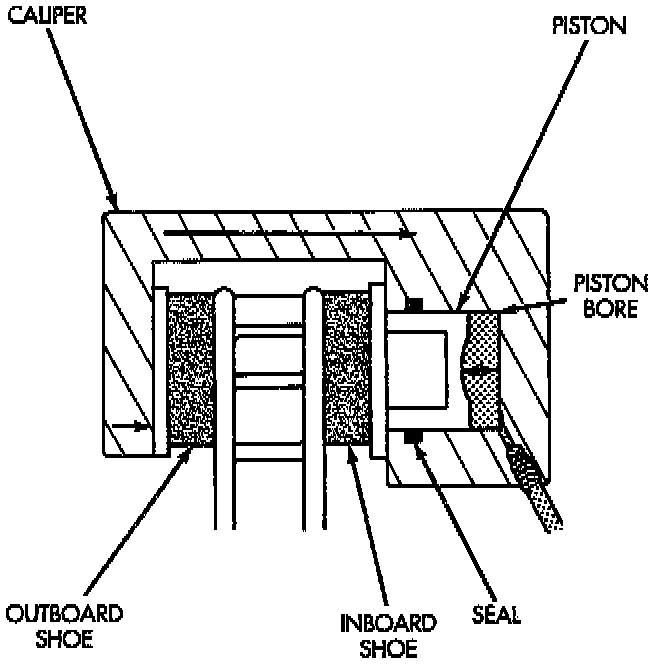
When the brakes are applied fluid pressure is exerted against the caliper pistons. The fluid pressure is exerted equally and in all directions. This means pressure exerted against the caliper pistons and within the caliper bores will be equal.
Fluid pressure applied to the pistons is transmitted directly to the inboard brake pad. This forces the pad lining against the inner surface of the disc brake rotor. At the same time, fluid pressure within the piston bores forces the caliper to slide inward on the slide pins. This action brings the outboard brake pad lining into contact with the outer surface of the disc brake rotor.
Fluid pressure acting simultaneously on the pistons and caliper to produces a strong clamping action. When sufficient force is applied, friction will stop the rotors from turning and bring the vehicle to a stop.
Application and release of the brake pedal generates only a very slight movement of the caliper and pistons. Upon release of the pedal, the caliper and pistons return to a rest position. The brake pads do not retract an appreciable distance from the rotor. In fact, clearance is usually at, or close to zero. The reasons for this are to keep road debris from getting between the rotor and lining and in wiping the rotor surface clear each revolution.
The caliper piston seals control the amount of piston extension needed to compensate for normal lining wear.
Fig. 2 Piston Seal Function:
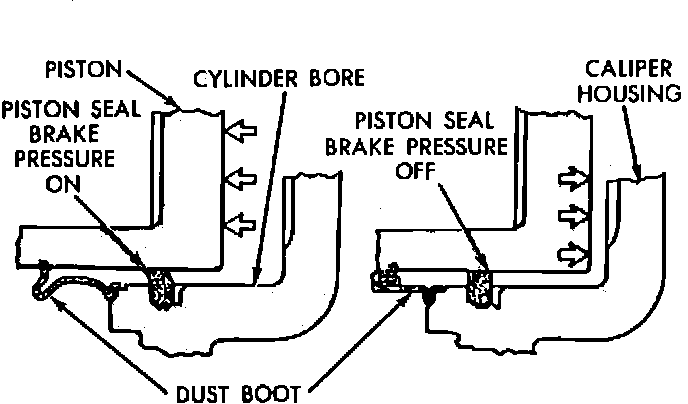
During brake application, the seals are deflected outward by fluid pressure and piston movement. When the brakes (and fluid pressure) are released, the seals relax and retract the pistons.
The front outboard brake pads have wear indicators.