Part 3 of 5
FRONT WIPER ARMThe front wiper arms are the rigid members located between the wiper pivots that protrude from the cowl plenum cover/grille panel near the base of the windshield and the wiper blades on the windshield glass. These wiper arms feature an over-center hinge that allows easy access to the windshield glass for cleaning. The wiper arm has a die cast metal pivot end with a large mounting hole with internal serrations at one end. A molded black plastic cap fits over the wiper arm retaining nut to conceal the nut and this mounting hole following wiper arm installation. The wide end of a tapered, stamped steel channel hinges on and is secured with a hinge pin to the blade end of the wiper arm pivot end. One end of a long, rigid, stamped steel strap, with a small hole near its pivot end, is riveted and crimped within the narrow end of the stamped steel channel. The tip of the wiper blade end of this strap is bent back under itself to form a small hook. Concealed within the stamped steel channel, one end of a long spring is engaged with a wire hook on the underside of the die cast pivot end, while the other end of the spring is hooked through the small hole in the steel strap. The entire wiper arm has a satin black finish applied to all of its visible surfaces.
A wiper arm cannot be adjusted or repaired. If damaged or faulty, the entire wiper arm unit must be replaced.
The front wiper arms are designed to mechanically transmit the motion from the wiper pivots to the wiper blades. The wiper arm must be properly indexed to the wiper pivot in order to maintain the proper wiper blade travel on the glass. The mounting hole formation with internal serrations in the wiper arm pivot end interlocks with the serrations on the outer circumference of the wiper pivot driver, allowing positive engagement and finite adjustment of this connection. The mounting nut locks the wiper arm to the threaded stud on the wiper pivot. The spring- loaded wiper arm hinge controls the down-force applied through the tip of the wiper arm to the wiper blade on the glass. The hook formation on the tip of the wiper arm provides a cradle for securing and latching the wiper blade pivot block to the wiper arm.
Wiper Blade Remove/Install - Typical:
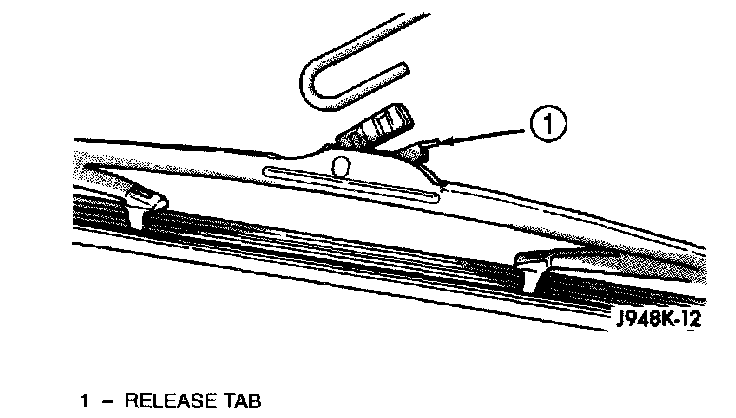
FRONT WIPER BLADE
Each front wiper blade is secured by an integral latching pivot block to the hook formation on the tip of the front wiper arms, and rests on the glass near the base of the windshield when the wipers are not in operation. The wiper blade consists of the following components:
- Superstructure - The superstructure includes several stamped steel bridges and links with claw formations that grip the wiper blade element. Also included in this unit is the latching, molded plastic pivot block that secures the superstructure to the wiper arm. All of the metal components of the wiper blade have a satin black finish applied.
- Element - The wiper element or squeegee is the resilient rubber member of the wiper blade that contacts the glass.
- Flexor - The flexor is a rigid metal component running along the length of each side of the wiper element where it is gripped by the claws of the superstructure.
All Grand Cherokee models have two 52.50 centimeter (20.67 inch) long windshield wiper blades with non-replaceable rubber elements (squeegees). The wiper blades cannot be adjusted or repaired. If faulty, worn, or damaged the entire wiper blade unit must be replaced.
The wiper blades are moved back and forth across the glass by the wiper arms when the wipers are being operated. The wiper blade superstructure is the flexible frame that grips the wiper blade element and evenly distributes the force of the spring-loaded wiper arm along the length of the element. The combination of the wiper arm force and the flexibility of the superstructure makes the element conform to and maintain proper contact with the glass, even as the blade is moved over the varied curvature found across the glass surface. The wiper element flexor provides the claws of the blade superstructure with a rigid, yet flexible component on the element which can be gripped. The rubber element is designed to be stiff enough to maintain an even cleaning edge as it is drawn across the glass, but resilient enough to conform to the glass surface and flip from one cleaning edge to the other each time the wiper blade changes directions.
Fig.11 Front Wiper Module:
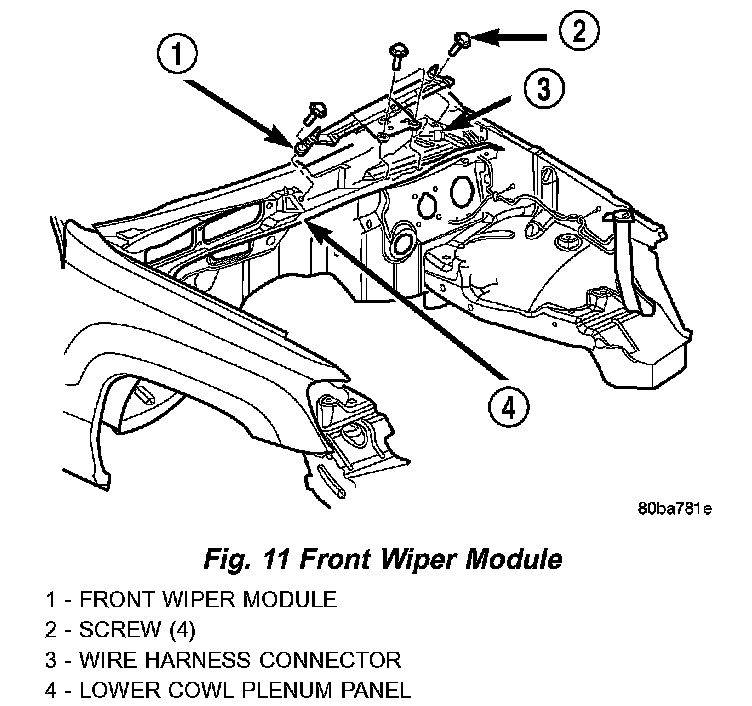
FRONT WIPER MODULE
The front wiper module is secured with four screws through rubber isolators to the cowl plenum panel beneath the cowl plenum cover/grille panel. The ends of the wiper pivot shafts that protrude through dedicated openings in the cowl plenum cover/grille panel to drive the wiper arms and blades are the only visible components of the front wiper module. The front wiper module consists of the following major components:
- Bracket - The front wiper module bracket consists of a long tubular steel main member that has a stamped pivot bracket formation near each end where the two wiper pivots are secured. A stamped steel mounting plate for the wiper motor is secured with welds near the center of the main member.
- Crank Arm - The front wiper motor crank arm is a stamped steel unit with a slotted hole on the driven end that is secured to the wiper motor output shaft with a nut, and a ball stud secured to the drive end.
- Linkage - Two stamped steel drive links connect the wiper motor crank arm to the pivot lever arms. The passenger side drive link has a plastic socket-type bushing on each end. The driver side drive link has a plastic socket-type bushing on one end, and a plastic sleeve-type bushing on the other end. The socket-type bushing on one end of each drive link is snap-fit over the ball stud on the lever arm of its respective pivot. The driver side drive link sleeve-type bushing end is then fit over the motor crank arm ball stud, and the other socket-type bushing of the passenger side drive link is snap-fit over the exposed end of the wiper motor crank arm ball stud.
- Motor - The front wiper motor is secured with three screws to the motor mounting plate near the center of the wiper module bracket. The wiper motor output shaft passes through a hole in the module bracket, where a nut secures the wiper motor crank arm to the motor output shaft. The two-speed permanent magnet wiper motor features an integral transmission, an internal park switch, and an internal automatic resetting circuit breaker.
- Pivots - The two front wiper pivots are secured to the ends of the wiper module bracket. The crank arms that extend from the bottom of the pivot shafts each have a ball stud on their end. The upper end of each pivot shaft where the wiper arms will be fastened each has an externally serrated drum with a threaded stud secured to it.
The front wiper module cannot be adjusted or repaired. If any component of the module is faulty or damaged, the entire front wiper module unit must be replaced. The reinforcement bracket and stud plate are available for service replacement.
The front wiper module operation is controlled by the battery current inputs received by the wiper motor from the wiper ON/OFF and wiper high/low relays. The wiper motor speed is controlled by current flow to either the low speed or the high speed set of brushes. The park switch is a single pole, single throw, momentary switch within the wiper motor that is mechanically actuated by the wiper motor transmission components. The park switch alternately closes the wiper park switch sense circuit to ground or to battery current, depending upon the position of the wipers on the glass. This feature allows the motor to complete its current wipe cycle after the wiper system has been turned OFF, and to park the wiper blades in the lowest portion of the wipe pattern. The automatic resetting circuit breaker protects the motor from overloads. The wiper motor crank arm, the two wiper linkage members, and the two wiper pivots mechanically convert the rotary out-put of the wiper motor to the back and forth wiping motion of the wiper arms and blades on the glass.