Part 2 of 5
FRONT CHECK VALVEA front washer system check valve is standard equipment on this model The front check valve is integral to the front washer nozzle plumbing wye fitting located in the cowl plenum beneath the cowl plenum cover/grille panel near the base of the windshield. The check valve consists of a molded plastic body with a round center section. Three barbed hose nipples are formed in a wye configuration on the outside circumference of the center section of the valve body Within the check valve body, a small check valve operated by a small coiled spring restricts flow through the unit until the valve is unseated by a predetermined inlet fluid pressure. The front check valve cannot be adjusted or repaired and, if faulty or damaged, it must be replaced.
The front check valve provides more than one function in this application. It serves as a wye connector fitting between the cowl grille panel and washer nozzle sections of the front washer supply hose. It also prevents washer fluid from draining out of the front washer supply hoses back to the washer reservoir. This drain-back would result in a lengthy delay from when the front washer switch is actuated until washer fluid was dispensed through the front washer nozzles, because the front washer pump would have to refill the front washer plumbing from the reservoir to the nozzles. Finally the front check valve prevents washer fluid from siphoning through the front washer nozzles after the front washer system is turned OFF. When the front washer pump pressurizes and pumps washer fluid from the reservoir through the front washer plumbing, the fluid pressure overrides the spring pressure applied to the check valve and unseats the valve, allowing washer fluid to flow toward the front washer nozzles. When the front washer pump stops operating, spring pressure seats the check valve and fluid flow in either direction within the front washer plumbing is prevented.
FRONT WASHER HOSES/TUBES
The front washer plumbing consists of a small diameter rubber hose that is routed from the barbed outlet nipple of the front washer pump/motor on the washer reservoir along the filler neck into the engine compartment. In the engine compartment, a molded plastic in-line fitting with barbed nipples joins the washer hose to another section of hose that is routed near the left headlamp and dash wire harness to the cowl plenum area. The engine compartment washer hose passes from the engine compartment into the cowl plenum area through a dedicated hole with a rubber grommet near the left end of the cowl plenum panel. A molded plastic elbow fitting with barbed nipples joins the engine compartment hose to the cowl grille cover hose. The cowl grille cover washer hose is routed through routing clips on the underside of the cowl grille cover to a molded plastic wye fitting with barbed nipples and an integral check valve. The cowl grille cover hose is connected to one nipple on the wye fitting and the two washer nozzle hoses are connected to the other two wye fitting nipples. The washer nozzle hoses are routed along the underside of the cowl grille cover to the two washer nozzles.
Washer hose is available for service only as roll stock, which must then be cut to length. The molded plastic washer hose fittings cannot be repaired. If these fittings are faulty or damaged, they must be replaced.
Washer fluid in the washer reservoir is pressurized and fed by the front washer pump/motor through the front washer system plumbing and fittings to the two front washer nozzles. Whenever routing the washer hose or a wire harness containing a washer hose, it must be routed away from hot, sharp, or moving parts and sharp bends that might pinch the hose must be avoided.
FRONT WASHER NOZZLE
The two front washer nozzles have integral snap features that secure them in dedicated holes in the cowl plenum cover/grille panel located near the base of the windshield. The domed upper surface of the washer nozzle is visible on the top of the plenum cover/grille panel, and the nozzle orifice is oriented towards the windshield glass. The washer plumbing fittings for the washer nozzles are concealed beneath the cowl plenum cover/grille panel. These fluidic washer nozzles are constructed of molded plastic. The cowl plenum cover/grille panel must be removed from the vehicle to access the nozzles for service. The washer nozzles cannot be adjusted or repaired. If faulty or damaged, they must be replaced.
The two front washer nozzles are designed to dispense washer fluid into the wiper pattern area on the outside of the windshield glass. Pressurized washer fluid is fed to each nozzle from the washer reservoir by the front washer pump/motor through a single hose, which is attached to a barbed nipple on each front washer nozzle below the cowl plenum cover/grille panel. The washer nozzles incorporate a fluidic design, which causes the nozzle to emit the pressurized washer fluid as an oscillating stream to more effectively cover a larger area of the glass area to be cleaned.
Fig.5 Washer Pumps (Viewed From Bottom Of Reservoir):
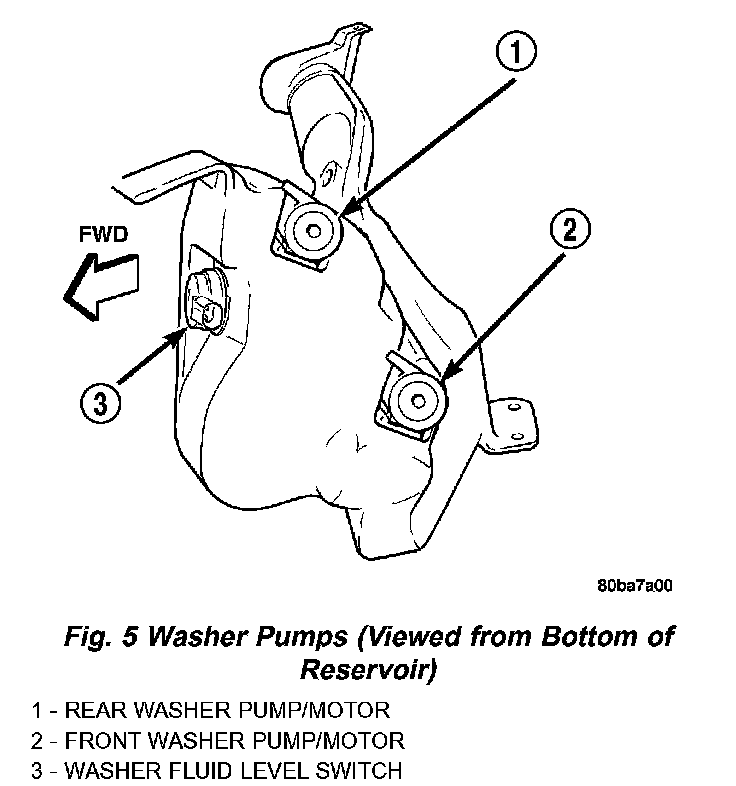
FRONT WASHER PUMP/MOTOR
The front washer pump/motor unit is located on the outboard side and near the front of the washer reservoir, between the left front inner and outer fender panels. A small permanently lubricated and sealed electric motor is coupled to the rotor-type washer pump. A seal flange with a large barbed inlet nipple on the pump housing passes through a rubber grommet seal installed in one of two dedicated mounting holes near the bottom of the washer reservoir. The front washer pump/motor unit is always mounted in the lower pump mounting hole of the reservoir. A smaller barbed outlet nipple on the pump housing connects the unit to the front washer hose. The washer pump/motor unit is retained on the reservoir by the interference fit between the barbed pump inlet nipple and the grommet seal, which is a light press fit. An integral electrical connector receptacle is located on the top of the motor housing. The front washer pump/motor unit cannot be repaired. If faulty or damaged, the entire washer pump/motor unit must be replaced.
The front washer pump/motor unit is connected to the vehicle electrical system through a single take out and two-cavity connector of the left headlamp and dash wire harness. The washer pump/motor is grounded at all times through a take out of the left headlamp and dash wire harness with a single eyelet terminal connector that is secured under a ground screw to the top of the left inner fender shield in the engine compartment. The front washer pump/motor receives battery current on a fused ignition switch output (run-acc) circuit through the closed contacts of the momentary front washer switch within the right multi-function switch only when the switch control stalk is pulled towards the steering wheel. Washer fluid is gravity-fed from the washer reservoir to the inlet side of the washer pump. When the pump motor is energized, the rotor-type pump pressurizes the washer fluid and forces it through the pump outlet nipple, the front washer plumbing, and the front washer nozzles onto the windshield glass.