Rear Axle - 226RBA
DESCRIPTIONThe Rear Beam-design Aluminum (RBA) axle housing has an aluminum center casting (differential housing) with axle shaft tubes extending from either side. The tubes are pressed into the differential housing to form an one-piece axle housing. The axle has semi-floating axle shafts, meaning that vehicle load is supported by the axle shaft and bearings.
The differential case is a one-piece design. Differential bearing preload and ring gear backlash is adjusted with selective shims. Pinion bearing preload is set and maintained by the use of a collapsible spacer. The cover provides a means for inspection and service.
Optional Trac-lok differential differential has a one-piece differential case, and the same internal components as a standard differential, plus two clutch disc packs.
Optional Vari-Lok differential has a one-piece differential case, which contains the gerotor pump assembly and the clutch mechanism. The unit is serviced only as an assembly.
OPERATION
The axle receives power from the transfer case through the front propeller shaft. The front propeller shaft is connected to the pinion gear, which rotates the differential through the gear mesh with the ring gear bolted to the differential case. The engine power is transmitted to the axle shafts through the pinion mate and side gears. The side gears are splined to the axle shafts.
STANDARD DIFFERENTIAL
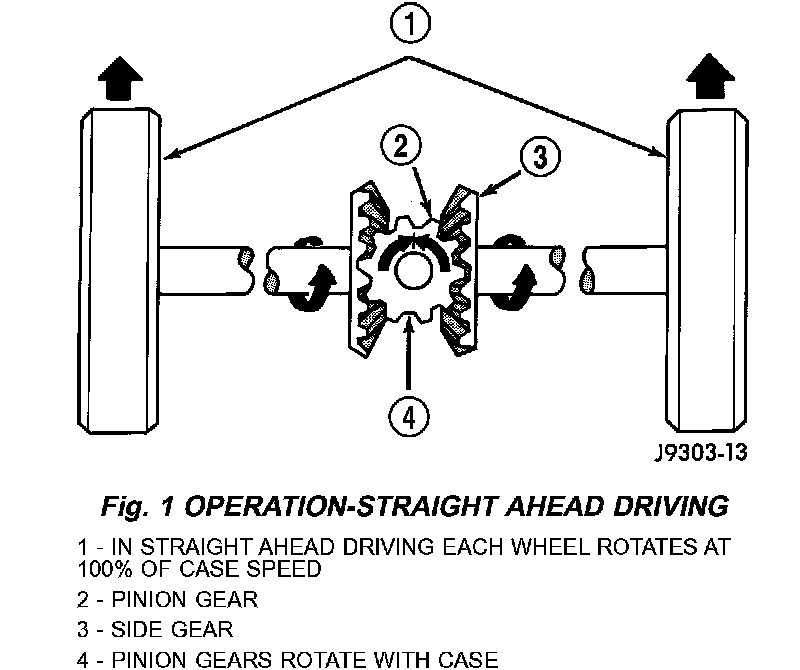
During straight-ahead driving the differential pinion gears do not rotate on the pinion mate shaft. This occurs because input torque applied to the gears is divided and distributed equally between the two side gears. As a result, the pinion gears revolve with the pinion mate shaft but do not rotate around it (Fig. 1).
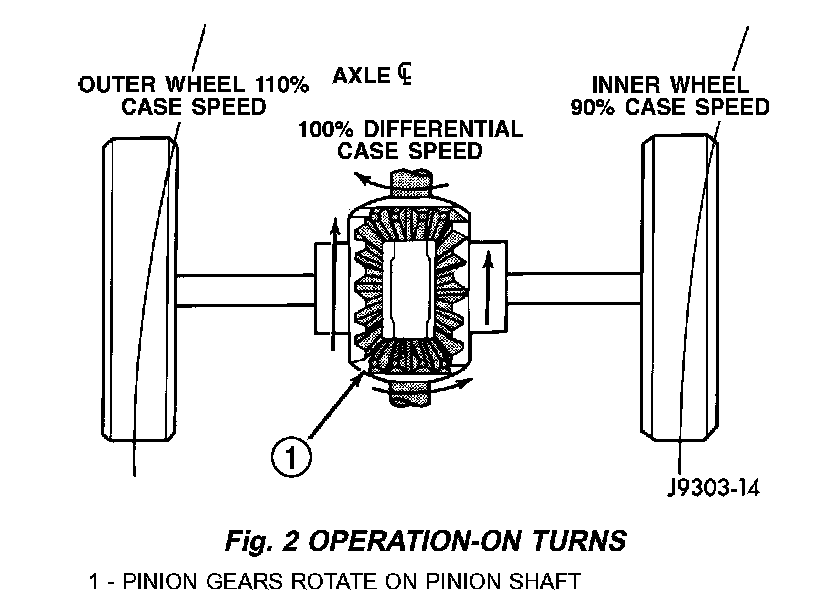
When turning corners, the outside wheel must travel a greater distance than the inside wheel to complete a turn. The difference must be compensated for to prevent the tires from scuffing and skidding through turns. To accomplish this, the differential allows the axle shafts to turn at unequal speeds (Fig. 2). In this instance, the input torque applied to the pinion gears is not divided equally. The pinion gears now rotate around the pinion mate shaft in opposite directions. This allows the side gear and axle shaft attached to the outside wheel to rotate at a faster speed.
TRAC-LOK DIFFERENTIAL
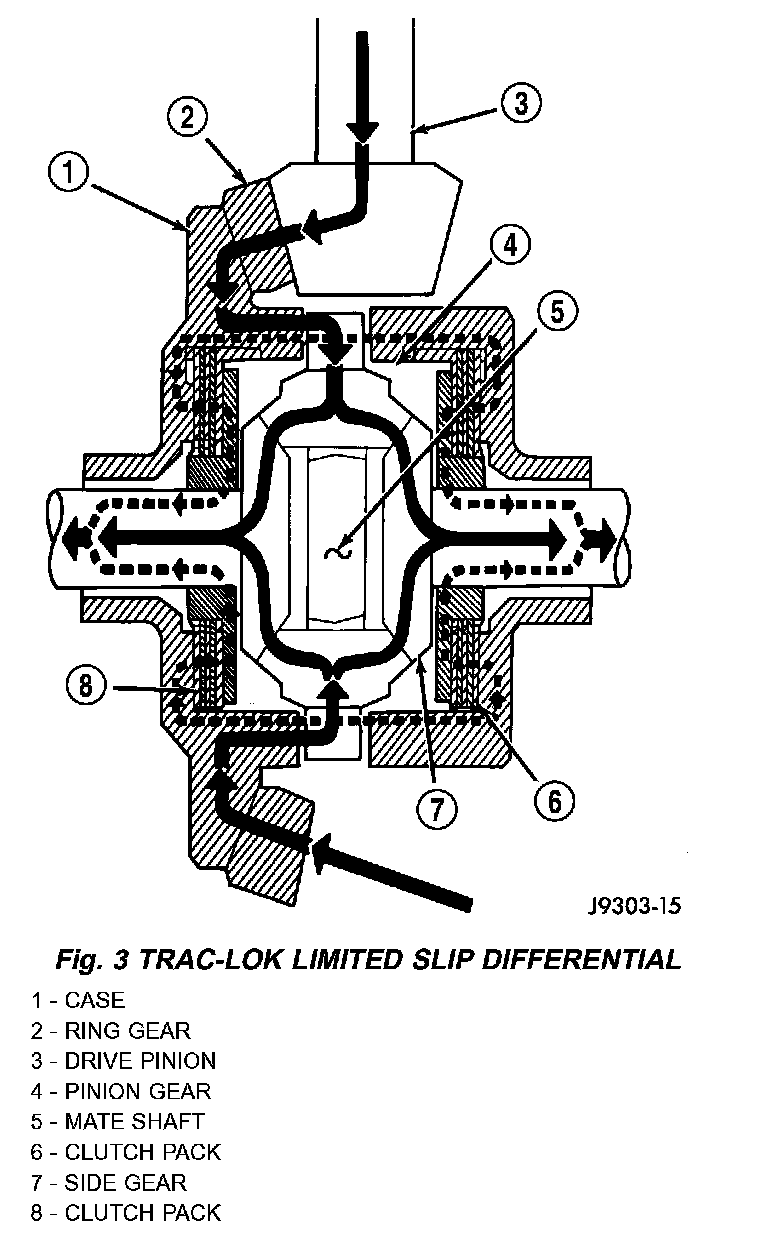
The differential clutches are engaged by two concurrent forces. The first being, the preload force exerted through Belleville spring washers within the clutch packs. The second is the separating forces generated by the side gears as torque is applied through the ring gear (Fig. 3).
This design provides the differential action needed for turning corners and for driving straight ahead during periods of unequal traction. When one wheel loses traction, the clutch packs transfer additional torque to the wheel having the most traction. The differential resists wheel spin on bumpy roads and provides more pulling power when one wheel loses traction. Pulling power is provided continuously until both wheels lose traction. If both wheels slip due to unequal traction, the operation is normal. In extreme cases of differences of traction, the wheel with the least traction may spin.
VARI-LOK DIFFERENTIAL
In a standard differential, if one wheel spins, the opposite wheel will generate only as much torque as the spinning wheel.
A gerotor pump and clutch pack are used to provide the torque transfer capability. One axle shaft is splined to the gerotor pump and one of the differential side gears, which provides the input to the pump. As a wheel begins to lose traction, the speed differential is transmitted from one side of the differential to the other through the side gears. The motion of one side gear relative to the other turns the inner rotor of the pump. Since the outer rotor of the pump is grounded to the differential case, the inner and outer rotors are now moving relative to each other and therefore creates pressure in the pump. The tuning of the front and rear axle orifices and valves inside the gerotor pump is unique and each system includes a torque-limiting pressure relief valve to protect the clutch pack, which also facilitates vehicle control under extreme side-to-side traction variations. The resulting pressure is applied to the clutch pack and the transfer of torque is completed.
Under conditions in which opposite wheels are on surfaces with widely different friction characteristics, Vari-Lok delivers far more torque to the wheel on the higher traction surface than do conventional Trac-lok systems. Because conventional Trac-lok differentials are initially pre-loaded to assure torque transfer, normal driving (where inner and outer wheel speeds differ during cornering, etc.) produces torque transfer during even slight side-to-side speed variations. Since these devices rely on friction from this preload to transfer torque, normal use tends to cause wear that reduces the ability of the differential to transfer torque over time. By design, the Vari-Lok system is less subject to wear, remaining more consistent over time in its ability to transfer torque. The coupling assembly is serviced as a unit. From a service standpoint the coupling also benefits from using the same lubricant supply as the ring and pinion gears.