Fuel Pressure Leak Down Test
FUEL PRESSURE LEAK DOWN TESTUse this test in conjunction with the Fuel Pump Pressure Test and Fuel Pump Capacity Test.
Check Valve Operation: The electric fuel pump outlet contains a one-way check valve to prevent fuel flow back into the tank and to maintain fuel supply line pressure (engine warm) when pump is not operational. It is also used to keep the fuel supply line full of gasoline when pump is not operational. After the vehicle has cooled down, fuel pressure may drop to 0 psi (cold fluid contracts), but liquid gasoline will remain in fuel supply line between the check valve and fuel injectors. Fuel pressure that has dropped to 0 psi on a cooled down vehicle (engine OFF) is a normal condition. When the electric fuel pump is activated, fuel pressure should immediately (1 - 2 seconds) rise to specification.
Abnormally long periods of cranking to restart a hot engine that has been shut down for a short period of time may be caused by:
- Fuel pressure bleeding past a fuel injector(s).
- Fuel pressure bleeding past the check valve in the fuel pump module.
- A defective fuel filter/pressure regulator.
Two # 6539, 5/16", Fuel Line Pressure Test Adapter Hose Tools are required for the following tests.
1. Release fuel system pressure. Refer to Fuel Pressure Release Procedure.
2. Raise vehicle.
Fig. 1 Disconnect Fuel Pressure Line At Filter/Regulator:
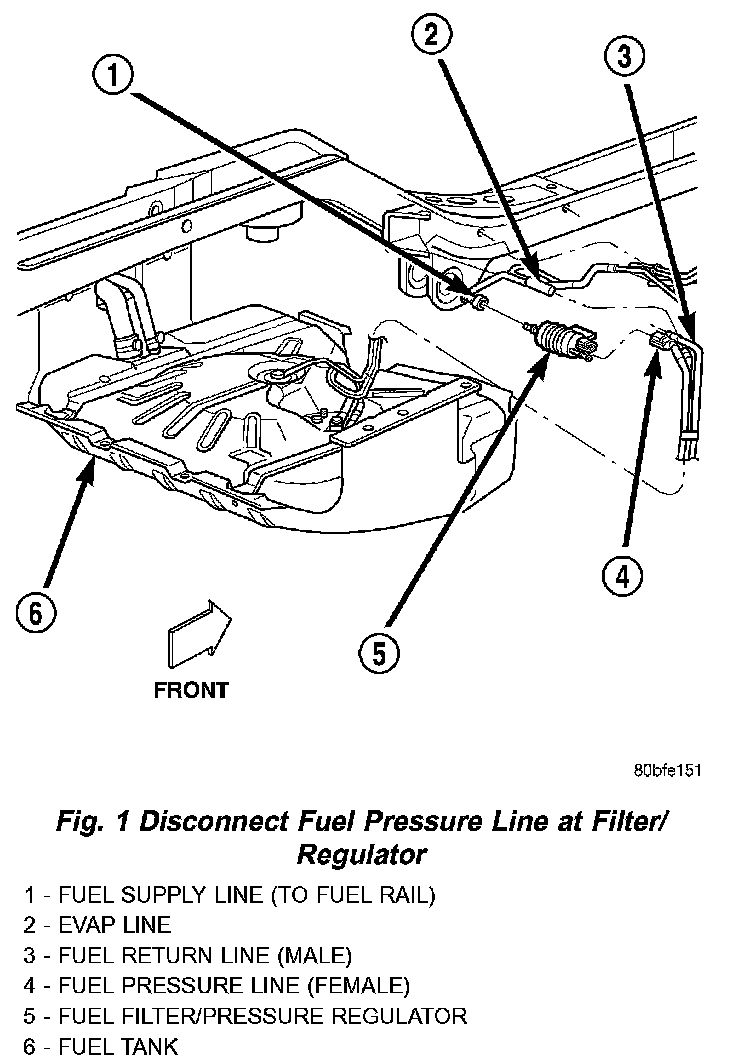
Fuel Line Identification: The fuel filter/pressure regulator is located in front of the fuel tank and above the rear axle. It is transversely mounted to a chassis crossmember (left-to-right). The filter/regulator is equipped with 3 fuel line fittings (2 at one end and 1 at the other end). The single fitting facing the left side of the vehicle is the supply line to the fuel rail (Fig. 1) . The 2 fittings facing the right side of the vehicle are connected to the fuel tank. Of these 2 fittings, the fitting towards the front is used for fuel return to the fuel tank. The fitting towards the rear is a pressure line. This rear fitting must be disconnected for the following step.
3. See previous step. Disconnect fuel pressure line at rear of filter/regulator. This is a 5/16" quick-connect fitting (Fig. 1). Refer to Quick-Connect Fittings for procedures.
4. Obtain correct Fuel Line Pressure Test Adapter Hose Tool # 6539 for 5/16" fuel lines. Connect one end of this Special Tool into the disconnected fuel pressure line. Connect the other end of the Tool into fitting on filter/regulator.
5. Lower vehicle.
6. Disconnect the fuel inlet line at fuel rail. Refer to Quick-Connect Fittings for procedures. On some engines, air cleaner housing removal may be necessary before fuel line disconnection.
Fig. 2 Connecting Adapter Tool - Typical:
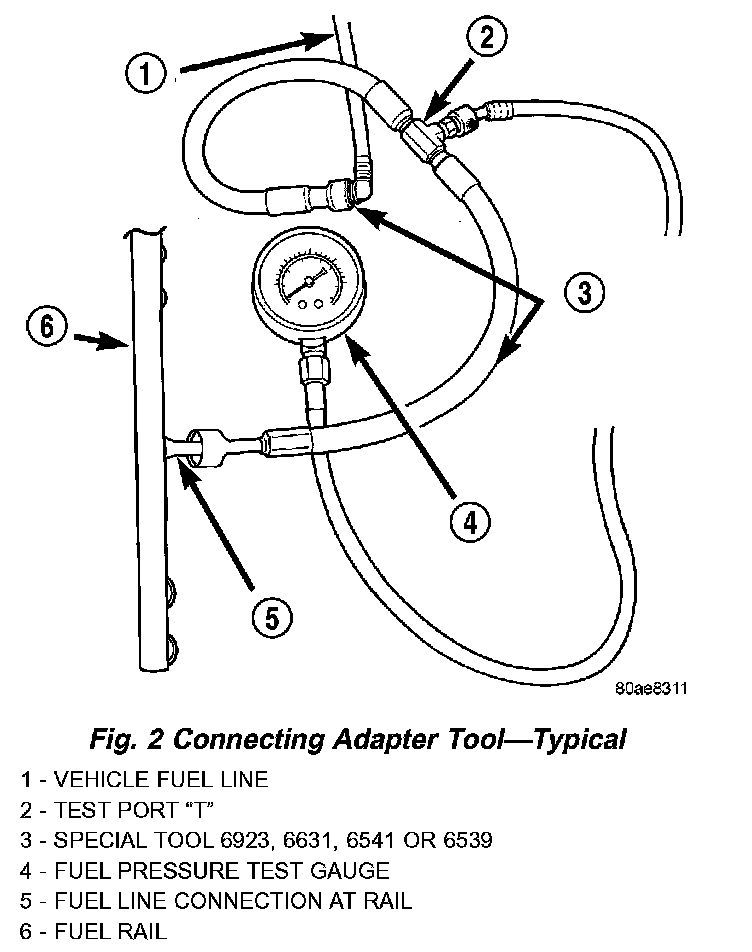
7. Obtain a second Fuel Line Pressure Test Adapter Hose Tool # 6539 for 5/16" fuel lines. Connect this tool between disconnected fuel line and fuel rail (Fig. 2)
8. Connect the 0 - 414 kPa (0 - 60 psi) fuel pressure test gauge (from Gauge Set 5069) to the test port on the appropriate Adaptor Tool. NOTE: The DRB III Scan Tool along with the PEP module, the 500 psi pressure transducer, and the transducer-to-test port adapter may also be used in place of the fuel pressure gauge.
CAUTION: The fittings on both tools must be in good condition and free from any small leaks before performing the proceeding test.
9. Start engine and bring to normal operating temperature.
10. Observe fuel pressure test gauge (or DRB screen). Normal operating pressure should be 339 kPa ± 34 kPa (49.2 psi ± 5 psi).
11. Shut engine off.
12. Pressure should not fall below 30 psi for five minutes.
13. If pressure falls below 30 psi, it must be determined if a fuel injector, the supply check valve within the fuel pump module, the fuel filter/pressure regulator, or a fuel tube/line is leaking.
14. Again, start engine and bring to normal operating temperature.
15. Shut engine off.
16. Testing for fuel injector or fuel rail leakage: Clamp off the rubber hose portion of the 6539 Adaptor Tool between the fuel rail and the test port on Adapter Tool (be sure clamping pressure is sufficient). If pressure now holds at or above 30 psi, a fuel injector or the fuel rail is leaking.
17. Again, start engine and bring to normal operating temperature.
18. Shut engine off.
19. Raise vehicle.
20. Testing for fuel filter/pressure regulator leakage: While continuing to securely clamp between the fuel rail and the test port "T" on Adaptor Tool 6539, securely clamp off any rubber hose portion of the Adaptor Tool 6539 that was installed between the fuel pressure line and the filter/regulator fitting (by restricting the pump module supply line's backflow, you isolate any leakdown originating from the filter/regulator via the tank return line.) If the pressure falls below 30 psi within 5 minutes, the filter/regulator is leaking. If it now holds at or above 30 psi, the electric fuel pump check valve is leaking or a fuel tube/line is leaking. A fuel odor presence would indicate the latter.
The electric fuel pump is not serviced separately. If replacement is necessary, replace the fuel pump module assembly The filter/regulator may be replaced separately Refer to Fuel Filter/Fuel Pressure Regulator Removal/Installation for additional information.