| Clicking noise coming from front hub when turning the steering wheel at low speed. |
Hub/Knuckle joint not fully engaged. |
Refer to: FRONT SUSPENSION
. |
| Noise from the front/rear suspension |
- Front suspension control arms
- Rear suspension control arms
|
|
- Rear wheel arch damage resulting in audible contact with the rear wheel
- Wheel position in rear wheel arch moved by more than 50 mm
- Wheel camber change by more than 10°
- Wheel camber change by more than 10°
- Steering wheel angle misalignment during straight ahead drive greater than 45°
- Steering wheel torque during straight ahead drive at low speed greater than 25nm
|
- The rear suspension has been subjected to an impact more than the capabilities it is designed for, resulting in the toe link fusing
|
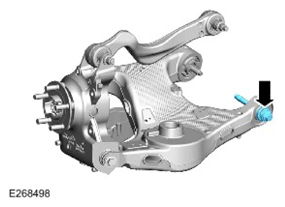 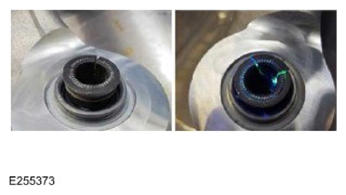 Courtesy of JAGUAR LAND ROVER NORTH AMERICA, LLCJAGUAR LAND ROVER NORTH AMERICA, LLC Courtesy of JAGUAR LAND ROVER NORTH AMERICA, LLCJAGUAR LAND ROVER NORTH AMERICA, LLC
Courtesy of JAGUAR LAND ROVER NORTH AMERICA, LLCJAGUAR LAND ROVER NORTH AMERICA, LLC
- Inspect the rear lower control arm cross axis joint on vehicles with a fused toe link (top graphic). If the cross axis joint is found to be damaged (lower graphic), install a new rear lower control arm as necessary
- Install a new rear knuckle, rear wheel bearing and hub on vehicles with a fused toe link
|
| Crabbing |
- Incorrect rear thrust angle
- Front or rear suspension components
|
- Check the rear alignment
- Check the front and rear suspension for signs of damage or wear
|
| Steering misalignment or vehicle Drift/pull/wander |
- Tire pressures incorrect
- Tire wear uneven
- Steering components worn/damaged
- Wheel alignment incorrect
- Brakes binding
|
Refer to the following:
Perform - "Pinpoint Test A: Steering Wheel Misaligned/Vehicle Pull/Drift". Refer to: STEERING SYSTEM
. |
| Front bottoming or riding low |
- Damaged suspension components
|
- Check the suspension components for damage
- Check the dynamic suspension
|
| Uneven tire wear |
- Incorrect tire pressure (rapid center rib or inner and outer edge wear)
- Incorrect front or rear toe (rapid inner or outer edge wear)
- Incorrect camber (rapid inner or outer edge wear)
- Tires out of balance (tires cupped or dished)
|
- Check and adjust the tire pressures (see visual inspection)
- Check and adjust the wheel alignment as necessary
- Balance the wheels and tires as necessary
|
| Harsh ride |
- Damaged suspension components
|
- Check the suspension components for damage
- Check the dynamic suspension
|
| Shimmy or Steering Wheel Vibration |
- Wheels/tires
- Loose wheel nut(s)
- Loose front suspension fasteners
- Front wheel bearing(s) fault
- Worn or damaged suspension component bushes
- Loose, worn or damaged ball joint(s)
- Loose, worn or damaged steering components
- Front wheel alignment
|
- Check the wheels and tires for condition and balance Refer to: STEERING WHEEL VIBRATION/SHIMMY WHILE DRIVING .
- Check and tighten the wheel nuts and suspension fasteners to specification
- Check the front wheel bearings, suspension bushes, ball joints and steering components for wear or damage
- Check and adjust the wheel alignment as necessary
|
| Poor return ability of the steering (self-centering) |
- Steering column
- Ball joints
- Steering components
|
- Check the steering column universal joints, etc
- Check the ball joints and other steering components
|
| Sway or roll |
- Loose front or rear stabilizer bar
- Worn lower suspension arm stabilizer bar insulators
|
- Check the stabilizer bar security and condition. Rectify as necessary
- Check the function of the active stabilization system (where installed)
|
| Vehicle leans to one side |
- Front or rear suspension components
|
- Check the front and rear suspension
|
| Evidence of fluid on shock absorber |
- Fluid on shock absorber from an external source
- Fluid leaking from shock absorber
|
|
| Snapping, clicking or popping noise |
- Damaged or worn front/rear suspension components
- Suspension fasteners loose
- Front or rear wheel bearing(s) worn
- Constant Velocity joint (CV) joint worn
|
|
| Grinding noise when the vehicle is in motion, intensifies when turning or when there is a shift in load |
- Foreign object(s) in brakes
- Front/rear, left/right brake pads/discs excessively worn
- Damaged or worn front/rear suspension components
- Suspension fasteners loose
- Front or rear wheel bearing(s) worn
|
|
| Humming, rumbling or growling noise when the vehicle is in motion, intensifies when turning the steering slightly to the left or right |
- Suspension fasteners loose
- Damaged or worn front/rear suspension components
- Uneven/irregular tire wear
- Front or rear wheel bearing(s) worn
|
|
|
NOTE:
All Wheel Drive (AWD) specific Humming, rumbling, or growling noise from the front of the vehicle at all speeds |
- Suspension fasteners loose
- Transmission internal failure
- Front half-shaft support bearing
- Damaged or worn front suspension components
- Worn or damaged driveshaft joint
- Front wheel bearing worn
|
|
| Humming, rumbling or growling noise from the rear of the vehicle varying at different vehicle speed and load |
- Suspension fasteners loose
- Damaged or worn rear suspension components
- Rear differential internal failure
- Worn or damaged driveshaft joint
- Rear wheel bearing worn
|
|