Test A: Tight Corner Braking Is Observed When Vehicle Is Subject To Full Steering Or 4WD System Drive Resistance Is Too Large To Get Sufficient Running Speed
- Check front and rear tire sizes. If tire sizes are correct, go to next step. If tire sizes are incorrect, replace tires with correct size. Go to step 16
.
- Check front and rear tire pressures. If tire pressures are correct, go to next step. If tire pressures are incorrect, correct pressure. Go to step 16
.
- Check front and rear tire wear patterns. If tire wear is uniform and normal, go to next step. If tire wear is abnormal, replace tires. Go to step 16
.
- Check front and rear tire type. If tire types are correct, go to next step. If tire types are incorrect, match tires and go to step 16
.
- Start engine. Shift transfer lever to high position. Fully turn steering wheel left or right. Put vehicle in "D" and make a tight turning braking maneuver. If tight turning braking occurs, go to next step. If tight turning braking does not occur, go to step 11
.
- Start engine. Shift transfer lever to 2H position. Fully turn steering wheel left or right. Put vehicle in "D" and make a tight corner braking maneuver. If tight corner braking occurs, go to next step. If tight corner braking does not occur, go to step 14
.
- Check if a limited slip differential is used. If a limited slip differential is used, go to next step. If no limited slip differential is used, go to step 9
.
- Check oil in differential. If correct limited slip differential oil is used, go to next step. If oil is incorrect, replace oil with correct limited slip differential and go to step 16
.
- Check engine power output. If power output is normal, go to next step. If power output is not normal, correct problem. Go to step 16
.
- Check for DTC affecting speed sensors. If speed sensors are okay, and no DTC exist, replace ECU. Go to step 16
. If speed sensors are failed, replace sensors and go to step 16
.
- If tight corner braking is only observed when brakes are applied, go to next step. If tight corner braking is observed with brakes not applied, go to step 5
.
- Turn ignition off. Disconnect ECU 30-pin connector. Turn ignition on. Using voltmeter, measure voltage between ECU connector pins No. 11 and 19. See Fig 1
. If battery voltage exists, go to next step. If battery voltage does not exist, replace ECU. Go to step 16
.
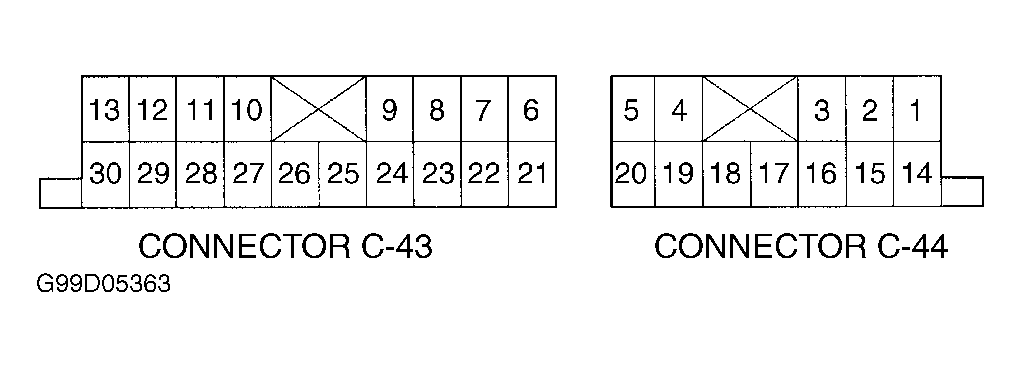 Courtesy of ISUZU MOTOR CO.
- With ECU disconnected, start engine. Apply brakes fully and make a tight corner braking maneuver. Measure voltage between ECU connector pins No. 4 and 20. If voltage ranges between .1-1.0 volt, problem is in transfer assembly. Repair as needed. If voltage is not .1-1.0 volts, replace ECU. Go to step 16
.
- With ECU disconnected, start engine. Shift transfer lever to high position. Fully turn steering wheel left or right and make a tight corner braking maneuver. Measure voltage between ECU connector pins No. 4 and 20. If voltage ranges between .1-1.0 volt, go to next step. If voltage is not .1-1.0 volts, replace ECU. Go to step 13
.
- Place 4WD switch in 2WD position. Raise right front wheel. If right front wheel turns freely, problem is in transfer assembly. Repair as needed. If right front wheel does not turn freely, problem is intermittent. See INTERMITTENTS
. Go to next step.
- Ensure that all mechanical and electrical components are mounted correctly. If all components are mounted correctly, test is complete. Recheck system operation. If any components are not mounted correctly, repair or replace as needed. Repeat drive test and see if symptom is repeated.