If the MIL (malfunction indicator lamp) has come on
- Start the engine, and check the MIL (A).
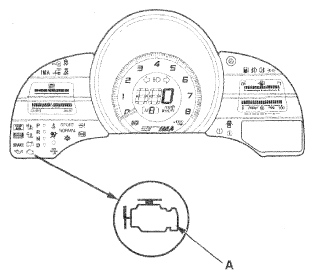 Courtesy of AMERICAN HONDA MOTOR CO., INC.
- If the MIL stays on, connect the HDS to the data link connector (DLC) (A) located under the driver's side of the dashboard.
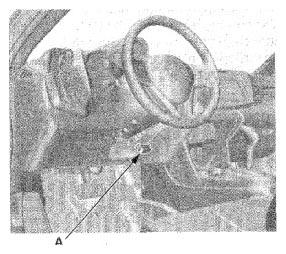 Courtesy of AMERICAN HONDA MOTOR CO., INC.
- Turn the ignition switch to ON (II).
- Make sure the HDS communicates with the ECM/PCM and all other vehicle systems. If it doesn't, go to the DLC circuit troubleshooting (see
DLC CIRCUIT TROUBLESHOOTING
).
- Check the diagnostic trouble code (DTC) and note it. Also check the freeze data and/or on-board snapshot data, and download any data found. Then refer to the indicated DTC'S TROUBLESHOOTING , and begin the appropriate troubleshooting procedure.
NOTE:
- Freeze data indicates the engine conditions when the first system malfunction, misfire, or fuel trim malfunction that activated the MIL was detected.
- The HDS can read the DTC, freeze data, on-board snapshot, current data, and other engine control module (ECM) or powertrain control module (PCM) data.
- For specific operations, refer to the
that came with the HDS.
- If no DTCs are found, go to MIL troubleshooting (see
MIL CIRCUIT TROUBLESHOOTING
).