Pinpoint Test B: DTCs C1700, C1703, C1706 And C1709
Parking Aid
Pinpoint Tests
Pinpoint Test B: DTCs C1700, C1703, C1706 And C1709
Refer to Wiring Diagram Set 131, Parking Aid for schematic and connector information. Diagrams By Number
Normal Operation
Voltage is supplied to the parking aid sensors from the Parking Aid Module (PAM) on circuit LMP07 (BU/WH). The PAM supplies ground to the parking aid sensors on circuit RMP07 (GN/WH). The PAM receives a signal from the parking aid sensors on circuits VMP14 (WH/OG), VMP15 (YE/GN), VMP16 (YE/GY) and VMP17 (YE/OG).
C1700-C1709:
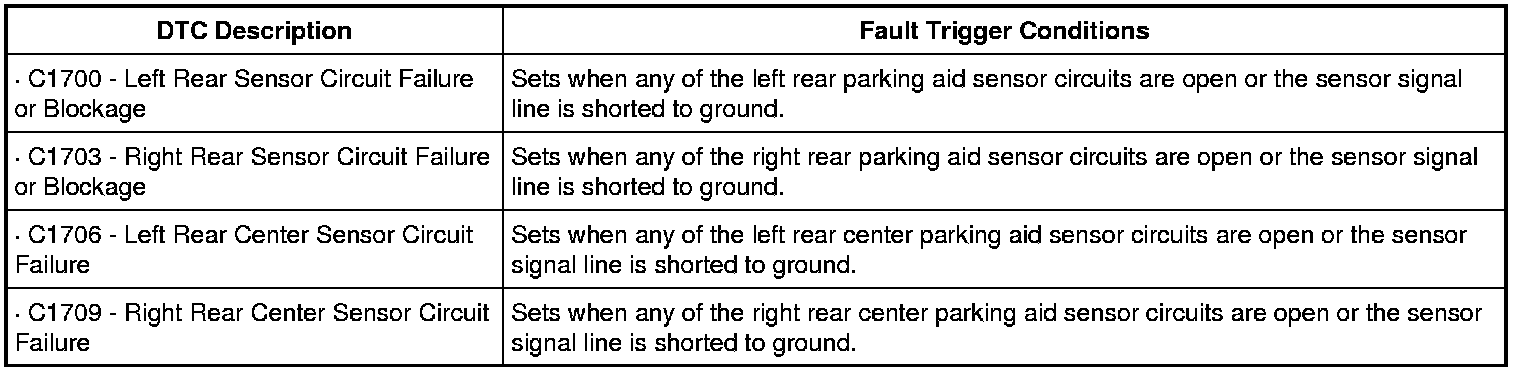
This pinpoint test is intended to diagnose the following:
- Wiring, terminals or connectors
- Parking aid sensor(s)
- Parking aid bumper harness
- PAM
PINPOINT TEST B: DTCs C1700, C1703, C1706 AND C1709
NOTICE: Use the correct probe adapter(s) when making measurements. Failure to use the correct probe adapter(s) may damage the connector.
-------------------------------------------------
B1 RETRIEVE THE DTCs FROM THE PAM SELF-TEST
- Check the PAM DTCs from the self-test.
- Are multiple DTCs recorded?
Yes
GO to B2 .
No
For DTCs C1700, C1703, C1706 and C1709, GO to B3.
For all other DTCs, REFER to DTC Charts. [1][2]Diagnostic Trouble Code Descriptions
-------------------------------------------------
B2 CHECK THE BUMPER WIRING HARNESS
- Inspect the bumper wiring harness for opens, shorts, grounds, or corrosion.
- Is the bumper wiring harness OK?
Yes
GO to B3.
No
REPAIR or INSTALL a new bumper wiring harness. CLEAR the DTCs. TEST the system for normal operation.
-------------------------------------------------
B3 CHECK THE SENSOR CIRCUITRY FOR OPENS
- Ignition OFF.
- Disconnect: Suspect Parking Aid Sensors C4009, C4010, C4011 and C4012.
- Disconnect: PAM C4014.
- Measure the resistance between the PAM C4014, harness side and the suspect parking aid sensor, harness side as follows:
C1700-C1709:
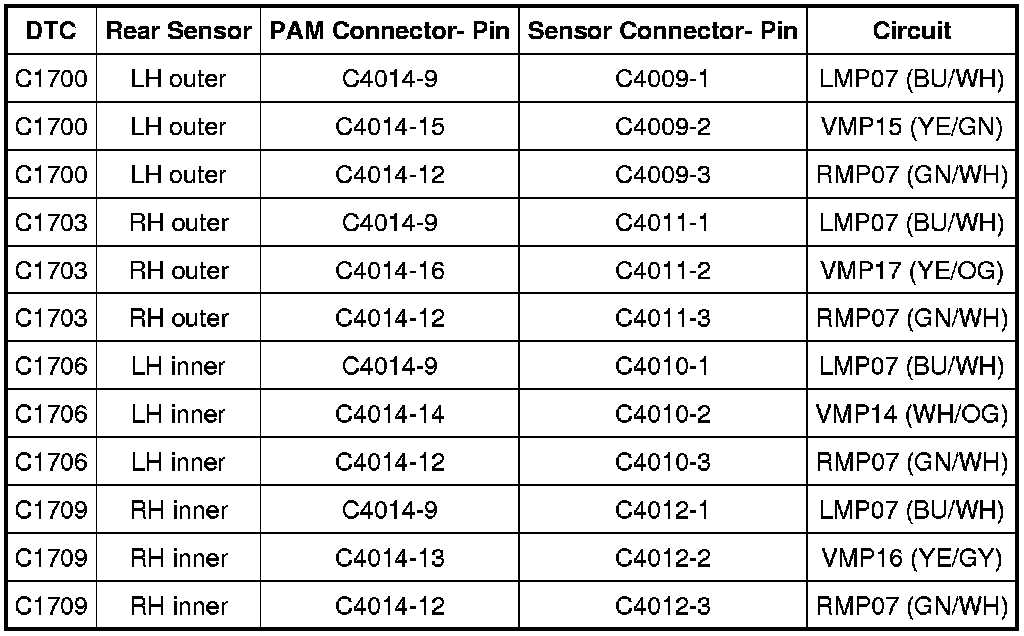
- Are the resistances less than 5 ohms?
Yes
GO to B4.
No
REPAIR the circuit in question. CLEAR the DTCs. TEST the system for normal operation.
-------------------------------------------------
B4 CHECK THE SENSOR CIRCUITRY FOR SHORTS TO GROUND
- Measure the resistance between the suspect parking aid sensor, harness side and ground as follows:
C1700-C1709:
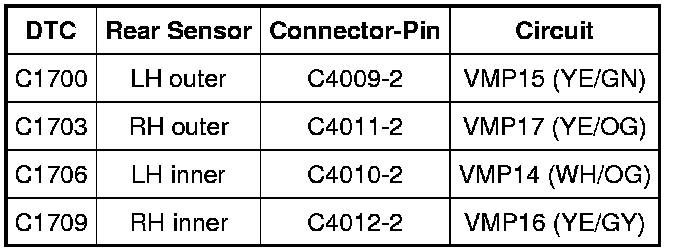
- Is the resistance greater than 10,000 ohms?
Yes
If all of the parking aid sensors recorded DTCs, GO to B5.
If one or more parking aid sensor(s) recorded DTCs, INSTALL a new sensor(s) for the one in question. REFER to Parking Aid Sensor Service and Repair. CLEAR the DTCs. TEST the system for normal operation.
No
REPAIR the circuit in question. CLEAR the DTCs. TEST the system for normal operation.
-------------------------------------------------
B5 CHECK FOR CORRECT PAM OPERATION
- Disconnect the PAM connector.
- Check for:
- corrosion
- damaged pins
- pushed-out pins
- Connect the PAM connector and make sure it seats correctly.
- Operate the system and determine if the concern is still present.
- Is the concern still present?
Yes
INSTALL a new PAM. REFER to Parking Aid Module (PAM) Service and Repair. TEST the system for normal operation.
No
The system is operating correctly at this time. The concern may have been caused by a loose or corroded connector. CLEAR the DTCs. TEST the system for normal operation.
-------------------------------------------------