P1626
Diagnostic Chart:
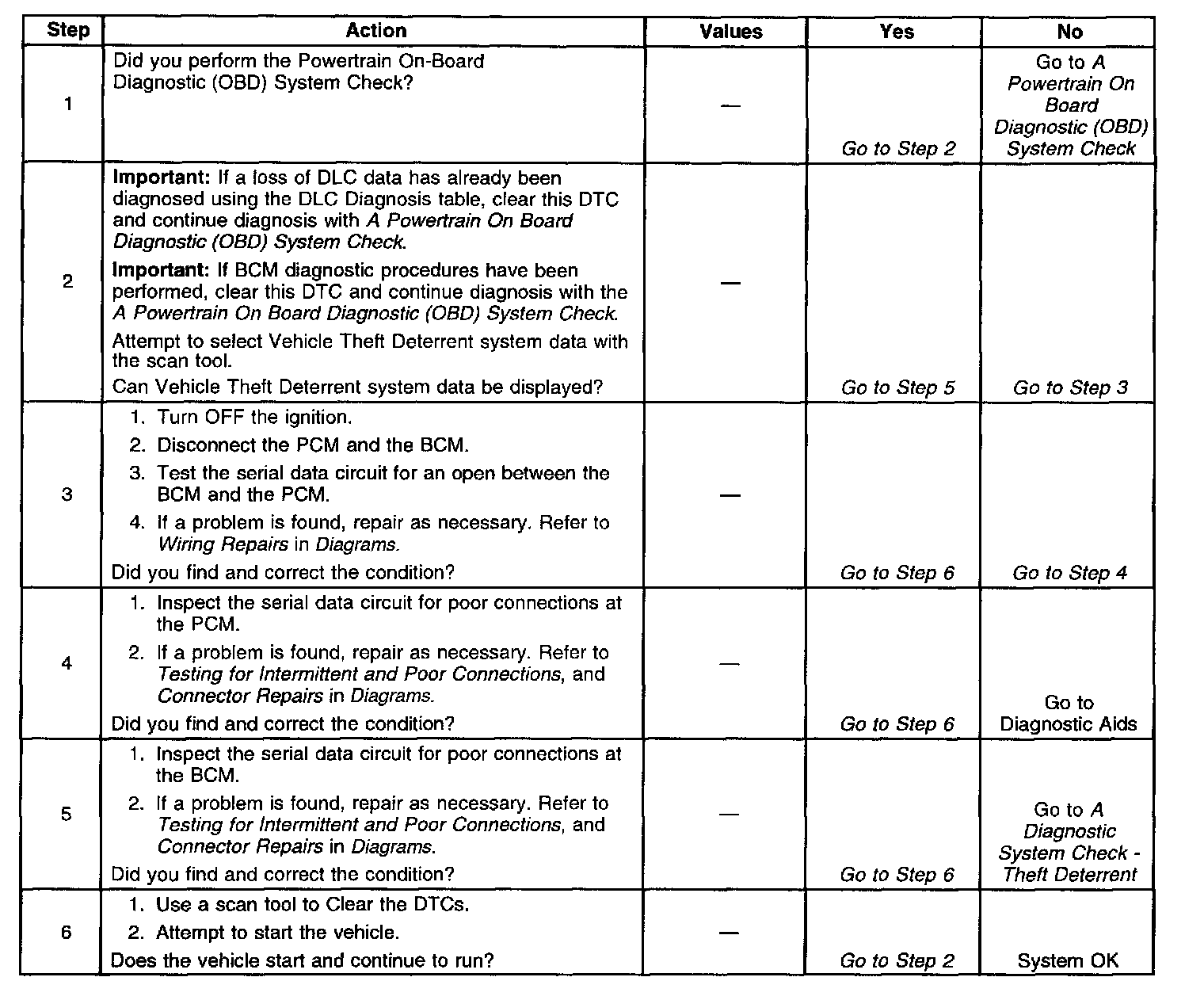
Refer to Engine Control Schematics Power, Grounds, MIL, Serial Data.
CIRCUIT DESCRIPTION
The Vehicle Theft Deterrent (VTD) system is incorporated within the Body Control Module (BCM). The PCM monitors the state of health serial data message from the theft deterrent system to ensure that the PCM to BCM communications is established. If the PCM detects a loss of the state of health message while the engine is running, DTC P1626 will set. DTC P1626 can cause a no-start condition or normal operation depending on when the loss of theft deterrent system communication was detected. The engine will continue to start and run if the condition that set DTC P1626 occurred after the PCM received a valid theft deterrent password from the BCM and already allowed fuel during the ignition cycle. The engine will start and immediately stall if the condition that set DTC P1626 occurred before the PCM received a valid theft deterrent password. With this condition present, the PCM will inhibit fuel delivery and disable the starter until a valid theft deterrent password is detected. Refer to Vehicle Theft Deterrent (VTD) Circuit Description in Theft Deterrent.
CONDITIONS FOR RUNNING THE DTC
The theft deterrent system has allowed fuel delivery.
CONDITIONS FOR SETTING THE DTC
The PCM has detected a loss of the state of health serial data message from the theft deterrent system.
ACTION TAKEN WHEN THE DTC SETS
^ The PCM will not illuminate the Malfunction Indicator Lamp (MIL).
^ The PCM will store conditions which were present when the DTC set as Failure Records data only. This information will not be stored as Freeze Frame data.
CONDITIONS FOR CLEARING THE MIL/DTC
^ A History DTC will clear after 40 consecutive warm-up cycles have occurred without a malfunction.
^ The DTC can be cleared by using a scan tool.
DIAGNOSTIC AIDS
For complete serial data line schematics and VTD system diagnosis, refer to DLC Diagnosis.
An intermittent may be caused by a poor connection, rubbed through wire insulation or a wire broken inside the insulation. Check for the following conditions:
IMPORTANT: Several BCM diagnostic procedures call for disconnecting the BCM and then turning the vehicle ignition to the RUN position. These procedures will result in the PCM setting DTC P1626. Therefore, DTC P1626 stored in history may be the result of previous BCM diagnostic work.
^ Intermittent short circuit on the serial data circuit. Refer to Data Link Connector (DLC) System Check in Electrical Diagnosis. Be sure to check all related wiring for an intermittent short to ground or short to voltage. Testing and Inspection
^ Poor connection - Inspect the PCM and BCM harness and connectors for the following conditions:
- Improper mating
- Broken locks
- Improperly formed or damaged terminals
- Poor terminal to wire connection
^ Damaged harness - Inspect the wiring harness for damage. Check for an intermittent short or open circuit in the wiring harnesses related to the BCM, including the ignition, battery feed, ground, and serial data circuits.
Reviewing the Failure Records vehicle mileage since the diagnostic test last failed may help determine how often the condition that caused the DTC to be set occurs. This may assist in diagnosing the condition.
If the DTC cannot be duplicated and is determined to be intermittent, reviewing the Failure Records can be useful in determining when the DTC was last set. Also refer to Testing for Intermittent and Poor Connections in Diagrams.