DTC 23
1 Of 3:

2 Of 3:
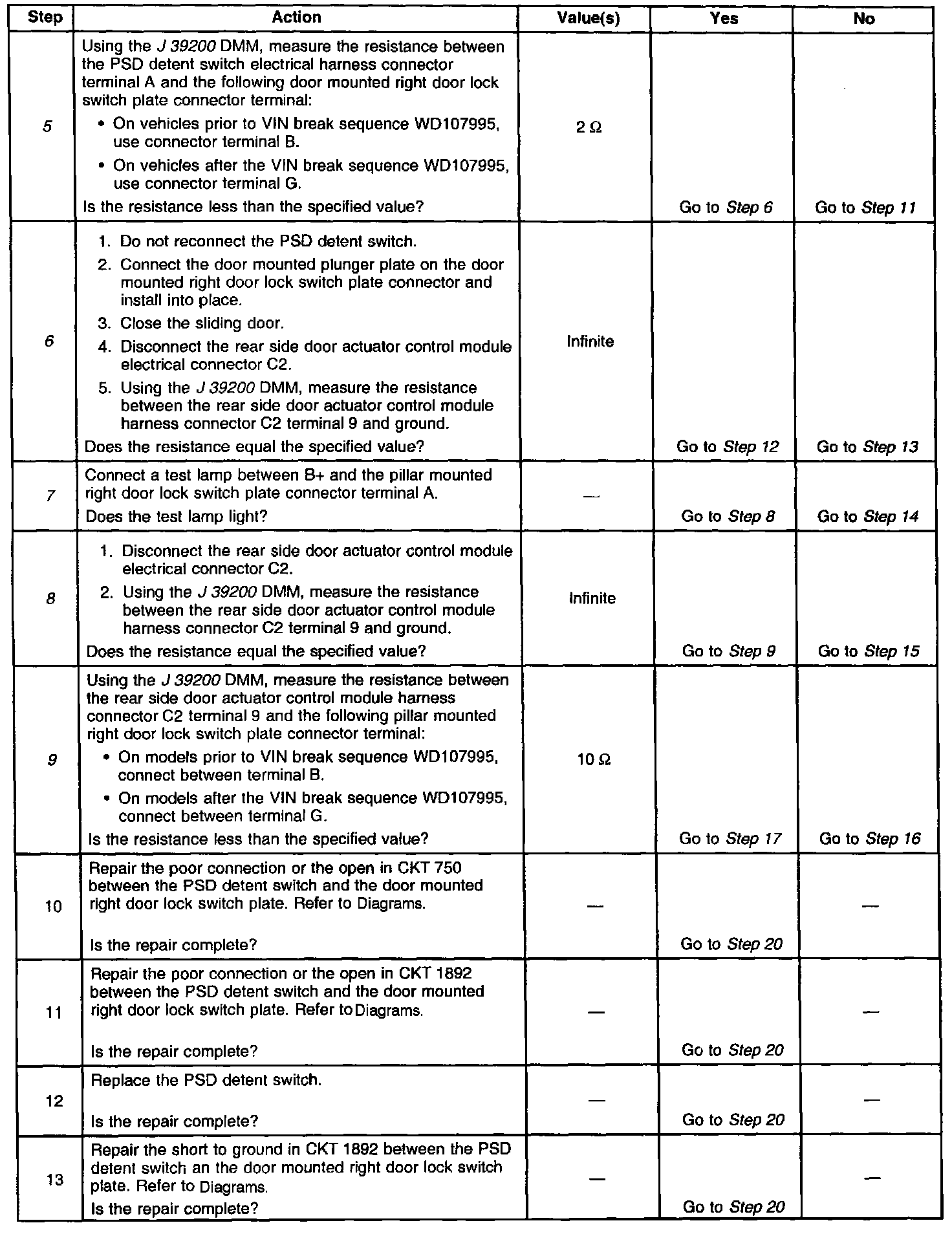
3 Of 3:
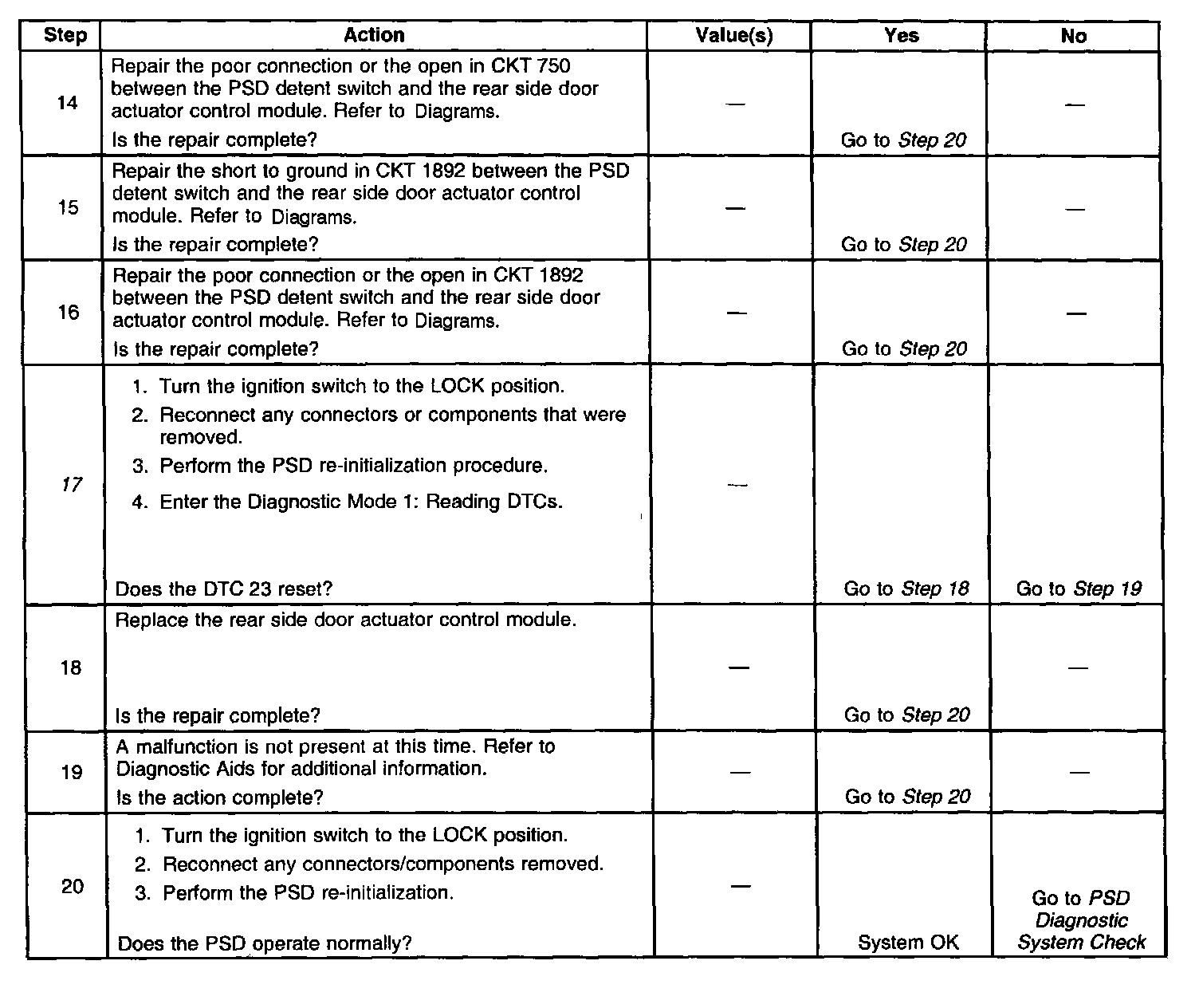
Circuit Description
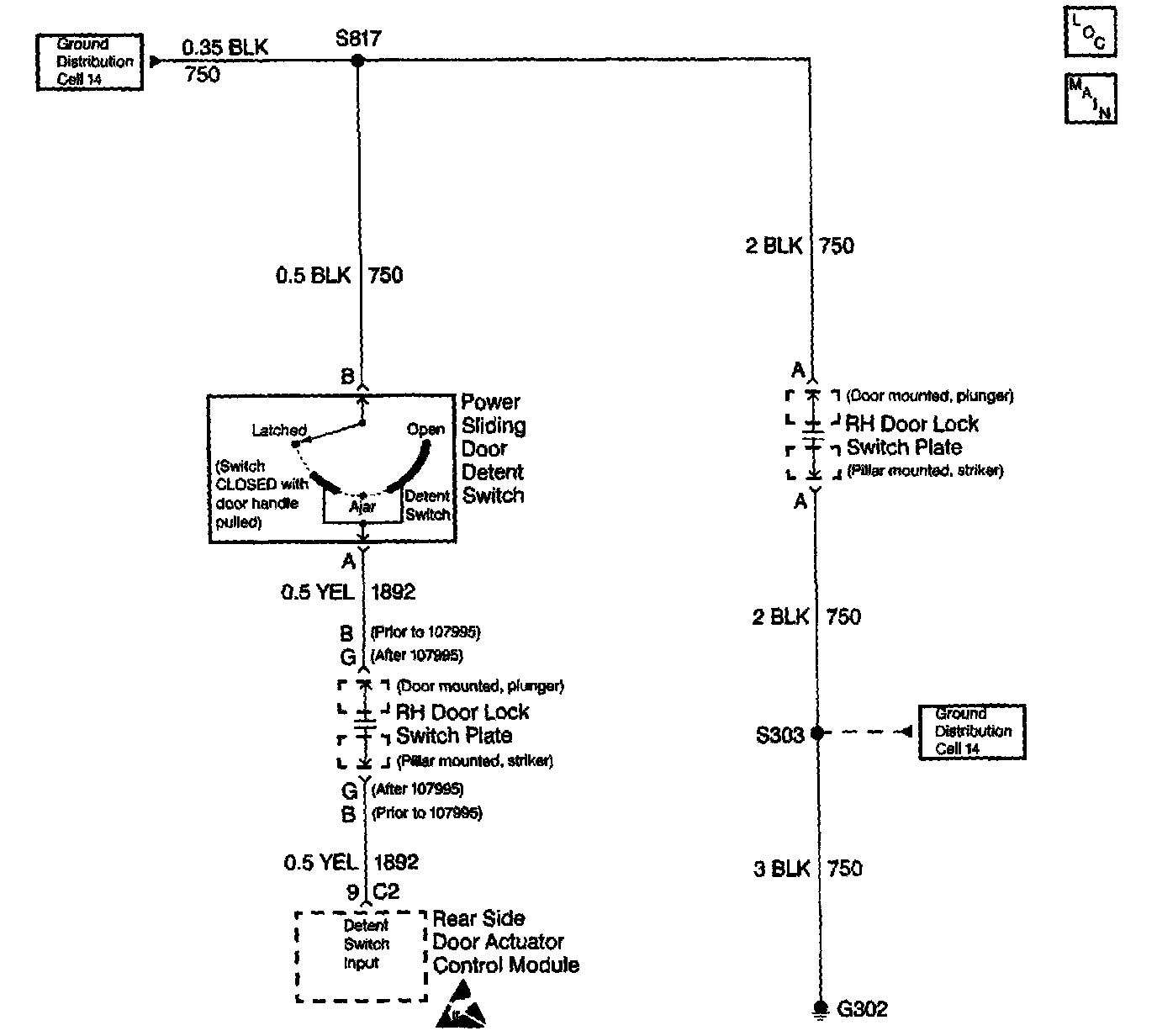
The rear side door actuator control module uses the PSD detent switch to determine when the sliding door is open, ajar, or latched. The PSD detent switch is part of the sliding door latch assembly. The PSD detent switch sends ground signals to the rear side door actuator control module through CKT 1892 indicating when the sliding door is open, ajar, or latched (fully closed). The PSD detent switch receives its ground through CKT 750. CKT 750 and CKT 1892 are completed through the switch plate plungers and pads located on the B-pillar.
When the PSD is closing and the sliding door is about 30 cm (12 in.) from being closed, the rear side door actuator control module reduces power to the cable motor. This action slows down the movement of the sliding door. Once the switch plate plungers and pads make contact, CKT 750 and CKT 1892 are completed and the rear side door actuator control module is able to monitor the door lock latch switch input.
When the sliding door latch moves from the open to the secondary latch (ajar) position, the PSD detent switch no longer sends a ground signal to the rear side door actuator control module, thus opening CKT 1892. This action signals the rear side door actuator control module that the sliding door has passed from the open door to the secondary latch (ajar) position. Upon detecting the door ajar position, the rear side door actuator control module sends full power to the cable motor.
As the sliding door continues to close, the sliding door latch moves from the ajar to the primary latch position. The PSD detent switch sends another ground signal to the rear side door actuator control module when the sliding door is between the secondary and primary latch position. This action signals the rear side door actuator control module that the sliding door has passed from ajar to door closed position. Then, the rear side door actuator control module disengages the clutch and de-energizes the cable motor.
Conditions for Setting the DTC
- The PSD has reached the full close (latched) position.
- The PSD detent switch has not sent a toggle signal.
Action Taken When the DTC Sets
- The PSD will not power open using door handle.
- The PSD is allowed to power open and close using open/close switch(es).
- The rear side door actuator control module sets DTC 23 in memory.
- The PSD alarm will sound when the transaxle is shifted out of PARK.
Conditions for Clearing the DTC
DTC 23 clears anytime the following actions occur:
- The sliding door is manually closed.
- The PSD controller receives a valid ground signal for secondary and primary latch positions from the detent switch.
Diagnostic Aids
- Perform the following:
- Check the door rods/latch: Inspect, adjust or replace the door lock rods and linkage. Refer to Lock Rod Adjustment - Sliding Door in Doors. Also, inspect, adjust or replace the rear latch. Refer to Lock Replacement - Sliding Door Rear in doors.
- Repair the electrical noise: Check the pads/plungers for secure attachment to body/door; replace pouch in fasteners if necessary. Check of corrosion, water entry, dirty or sticking plungers; clean or replace plungers. Check ground circuits. Check the detent switch; replace if necessary.
- Check the adjustment of the sliding door. Refer to Door Up/Down Adjustment - Sliding for up/down adjustment, Door Front Edge In/Out Adjustment - Sliding for door front edge in/out adjustment, or Door Rear Edge In/Out Adjustment - Sliding for door rear edge in/out adjustment.
- Inspect for the following conditions:
- Good interface of switch plate plungers and pads
- AnopeninCKTl892
- An open in CKT 750
- Poor G302
- A short to ground in CKT 1892
- A faulty PSD detent switch
- An intermittent failure may be difficult to detect and to accurately diagnose. Faulty electrical connections or wiring causes most intermittent problems. When an intermittent condition is suspected, inspect the suspected circuits for the following conditions:
- Poor mating of connector halves
- Backed out terminals
- Improperly formed or damaged terminals
- Wire chafing
- Poor wire-to-terminal connections
- Dirty or corroded terminals
- Damaged connector bodies
- A broken wire inside the insulation
- Does not latch to primary (AJAR)
- Door almost closes then releases to full open
- Use a J 35616-A whenever a diagnostic procedure requests probing or inspecting a terminal. Using the J 35616-A ensures that no damage to the terminal will occur. Using the J 35616-A provides an estimate of whether the contact tension is sufficient.
Important: CKT 294 and CKT 1892 have been changed around in the door and pillar mounted right door lock switch plate connectors to improve circuit operation. This was an on-going change through production. It is possible to have two different terminal configurations going into the door and pillar mounted right door lock switch plate connectors. The Vehicle Identification Number (VIN) break for the last change was sequence WD107995. The schematics and thumbnails illustrate these changes to these circuits.
In order to avoid any confusion, perform the following:
1. Remove the switch plates containing the plungers and pads so that the right door lock switch plate connectors can be probed directly.
2. Visually checking the circuits by their wire color and where they are on the connector (terminal cavity location) will allow the technician to probe at the correct point.
3. Use new X-mas tree fasteners when reinstalling the door lock switch plate plunger assembly.
Test Description
The number(s) below refer to the step number(s) on the diagnostic table.
2. This step performs the Diagnostic Mode 2: Input Test.
3. This step determines if the malfunction is in the sliding door or in the vehicle.
4. This step tests for an open in CKT 750 (door side).
5. This step tests for an open in CKT 1892 (door side).
6. This step determines if CKT 1892 is shorted to ground (door side) or if the PSD detent switch is faulty.
7. This step tests for an open in CKT 750 (vehicle side).
8. This step tests for a short to ground in CKT 1592 (vehicle side).
9. This step tests for an open in CKT 1892 (vehicle side).
17. This step determines if the malfunction is intermittent or if the rear side door actuator control module is faulty.