Vacuum Reservoir HVAC: Description and Operation
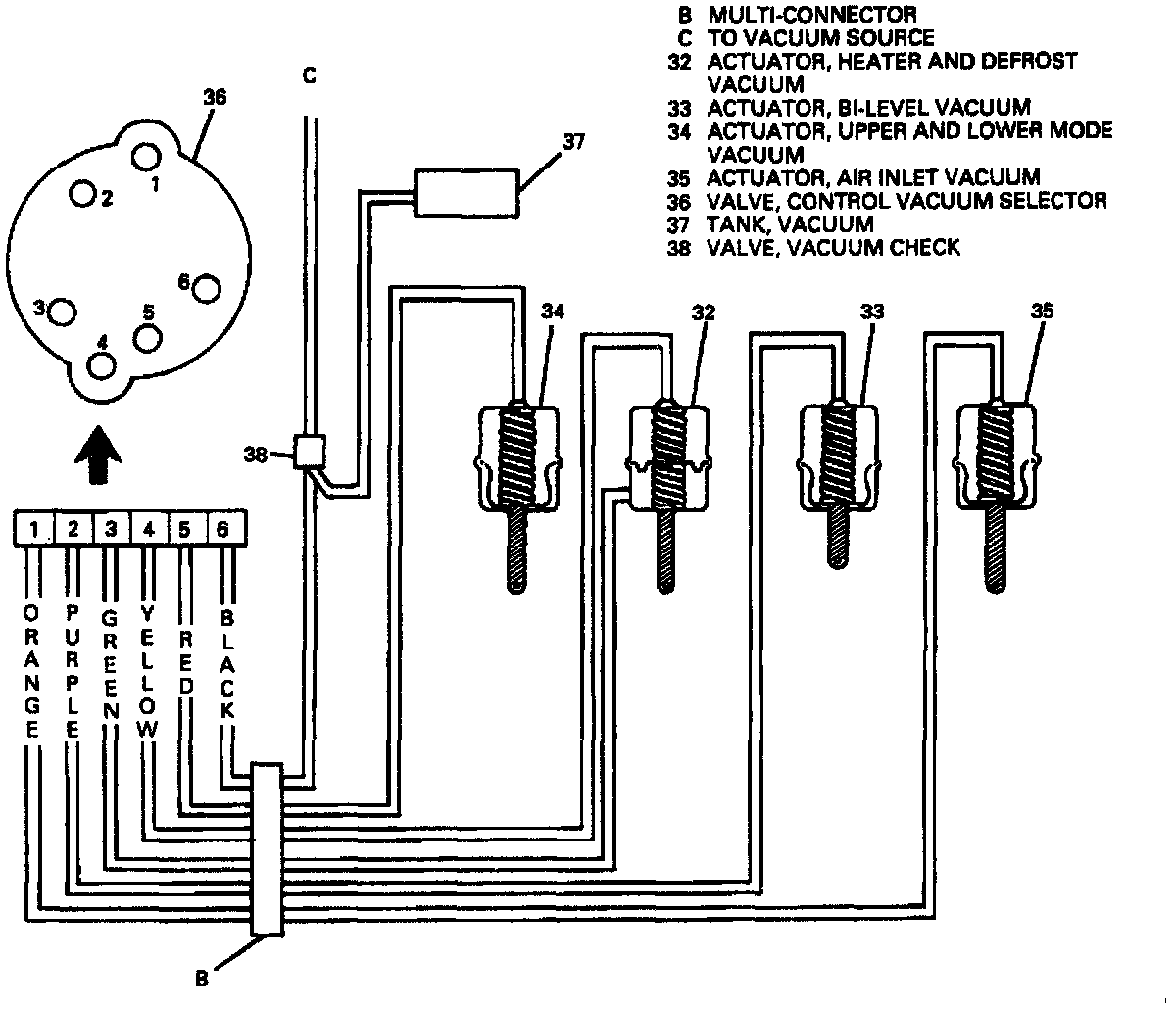
All valves in the heater and air conditioning evaporator module except the temperature valve are controlled by engine vacuum drawn from the vacuum tank, mounted to the right side body rail, just behind the radiator support. The vacuum is routed by a vacuum selector valve in the control to spring-loaded vacuum actuators on the heater and air conditioning evaporator module. Vacuum stored in the vacuum tank is prevented from bleeding back to its source during conditions of low engine manifold vacuum (acceleration, hard pulling, etc.) by a check valve in the vacuum source hose.
The vacuum selector valve in the control is controlled by the mode control. For each mode control position, the vacuum selector valve directs vacuum to specific hoses to overcome the force of the spring within the appropriate vacuum actuators. The vacuum selector valve also vents the hoses to each remaining vacuum actuator to normal air pressure, allowing the actuator spring to expand. This results in the valves (doors) being properly positioned for the selected operating mode.
The bi-level and vent valves have two-position vacuum actuators. When vacuum is directed to either actuator's vacuum chamber, the vacuum pulls in a flexible diaphragm that forms one wall of the chamber. This draws a movable shaft attached to the diaphragm. The shaft is linked to the corresponding valve, and it operates the valve when vacuum is applied.
When the vacuum chamber is vented to normal air pressure, an external spring moves the shaft back to its original position. The shaft, in turn, returns the valve to its original position.
The heater and defrost valve uses a three-position vacuum actuator. A three-position vacuum actuator has a diaphragm with a spring on both sides. At rest (no vacuum applied) the diaphragm will be in a mid-position, allowing for a blend mode. When vacuum is applied to either end of the diaphragm, the diaphragm will move the heater and defrost valve to either stop, which will direct airflow to either the defroster outlets or the floor outlets.
When air is directed to the floor outlets, as in HEATER setting, a small amount of air still bleeds through the defroster outlets to help eliminate re-fogging of the windshield.