P1336
Diagnostic Chart:
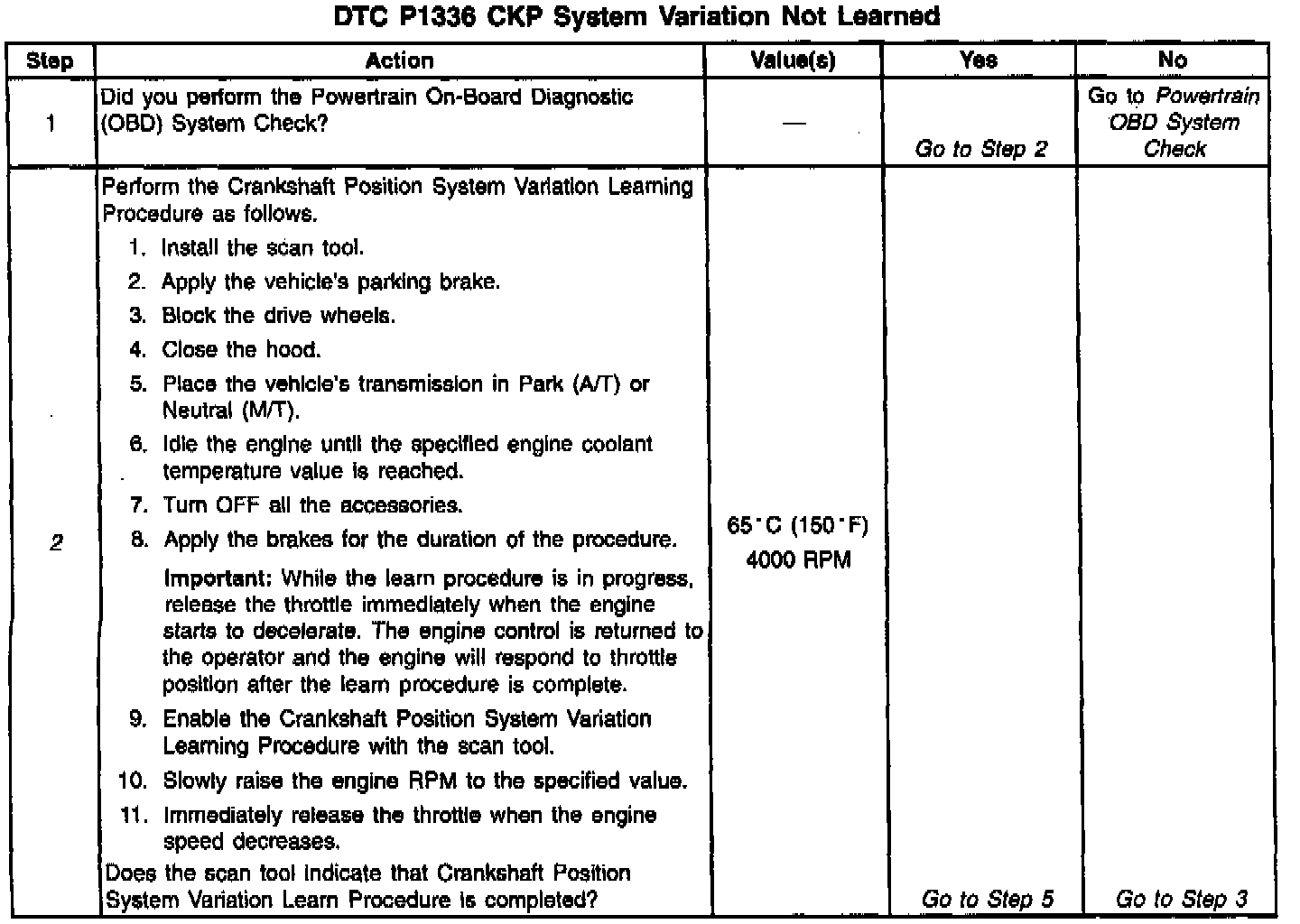
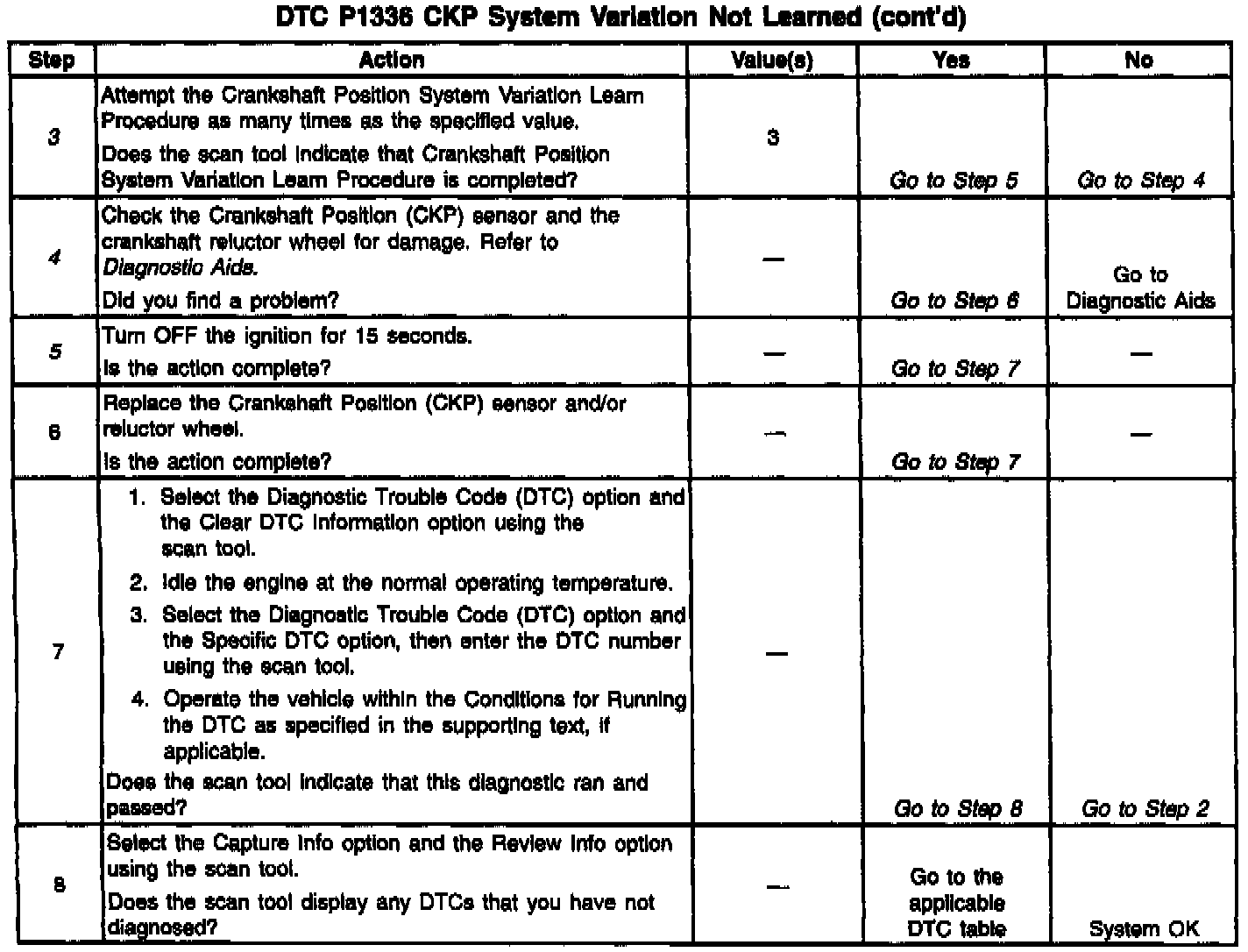
Diagnostic Chart:
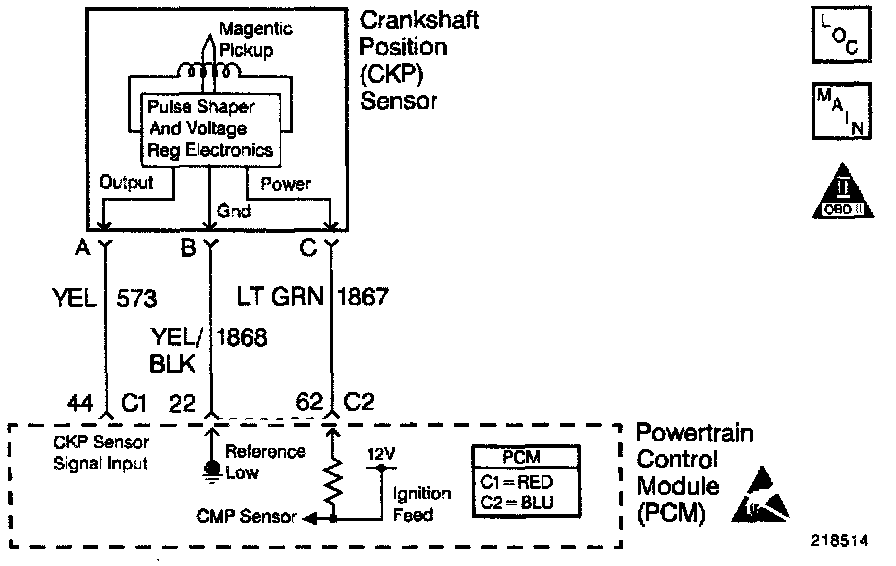
Wiring Diagram:
CIRCUIT DESCRIPTION
The Crankshaft Position (CKP) sensor sends pulses to the PCM as the reluctor wheel teeth rotate past the CKP sensor. The PCM uses the CKP pulses to synchronize the ignition and fuel injector operation, and to time the interval between each CKP pulse. The PCM determines when an excessive change in crankshaft speed occurs by comparing each new time interval with the previous interval. A misfire causes an unexpected change in the crankshaft speed. A certain amount of acceleration/deceleration is expected between each firing stroke, but if the crankshaft speed changes more than an expected amount, the PCM interprets this as a misfire. The interval between CKP sensor pulses is extremely small. At high engine speeds, slight variations in the following components make misfire detection difficult:
^ Crankshaft.
^ Reluctor wheel.
^ CKP sensor.
The PCM learns variations during the Crankshaft Position System Variation Learning Procedure. The PCM compensates for these variations when performing detect misfire calculations. Only a scan tool can command the PCM to perform the Crankshaft Position System Variation Learning Procedure again.
Perform the learning procedure after the following actions:
^ A PCM replacement.
^ Any operation or repair involving the crankshaft, the CKP sensor, or the CKP sensor to reluctor wheel gap relationship.
^ An engine replacement.
^ The ignition switch is in the ON position until the battery is drained.
IMPORTANT: A PCM power disconnect with the ignition ON may erase the stored pulse value and set the DTC P1336.
Disconnecting the PCM will not erase the learned Crankshaft Position System Variation as long as the ignition switch is in the OFF position.
IMPORTANT: Reprogramming the PCM does not require running the Crankshaft Position System Variation Learn Procedure unless the PCM is new or from another vehicle.
A DTC P1336 sets if the Crankshaft Position System Variation is not within an acceptable range, or can not be learned.
CONDITIONS FOR RUNNING THE DTC
There are no crankshaft position (CKP) or camshaft position (CMP) sensor DTCs
CONDITIONS FOR SETTING THE DTC
The PCM has not learned the Crankshaft Position System Variation.
ACTION TAKEN WHEN THE DTC SETS
^ The PCM illuminates the Malfunction Indicator Lamp (MIL) when the diagnostic runs and fails.
^ The PCM records the operating conditions at the time the diagnostic fails. The PCM stores this information in the Freeze Frame and/or the Failure Records.
CONDITIONS FOR CLEARING THE MIL/DTC
^ The PCM turns the MIL OFF after three consecutive drive trips that the diagnostic runs and does not fail.
^ A last test failed (current DTC) clears when the diagnostic runs and does not fail.
^ A History DTC clears after forty consecutive warm-up cycles, if this or any other emission related diagnostic does not report any failures.
^ The PCM battery voltage is interrupted. Use a scan tool in order to clear the MIL/DTC.