Hose Clamp Method
1. Raise the vehicle on twin post hoist so that vehicle is supported on rear axle housing and rear wheels are free to rotate.2. Remove both rear tires and wheels.
3. Install wheel nuts with flat sides next to rear brake drums or rotors.
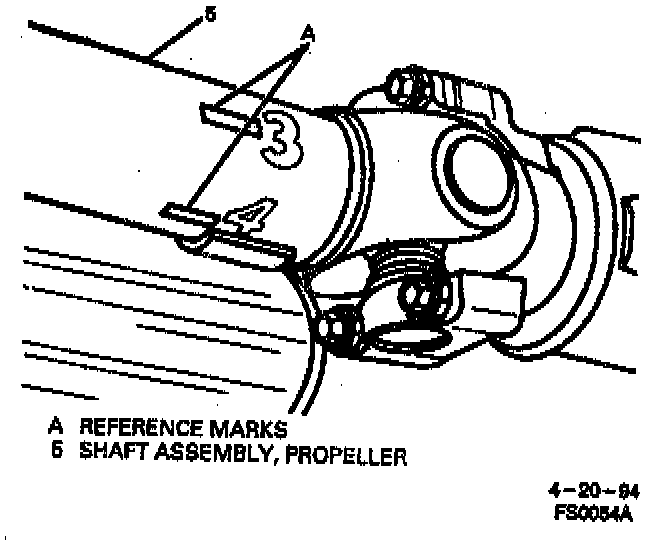
4. Mark and number propeller shaft (5) at four points, 90° apart, at rear of propeller shaft (5) just forward of balance weight.
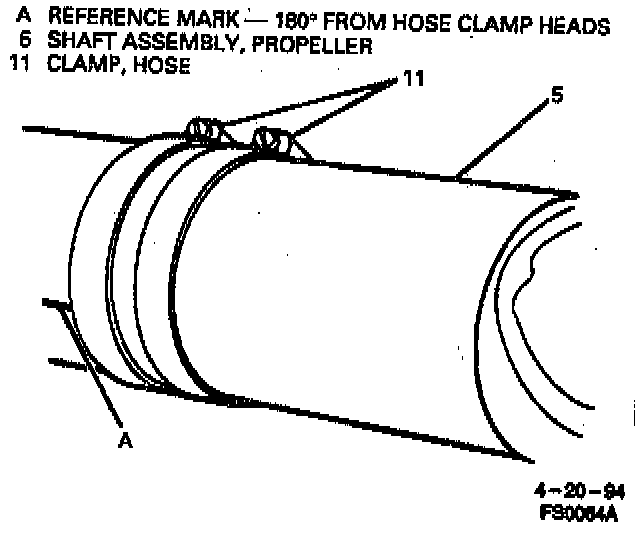
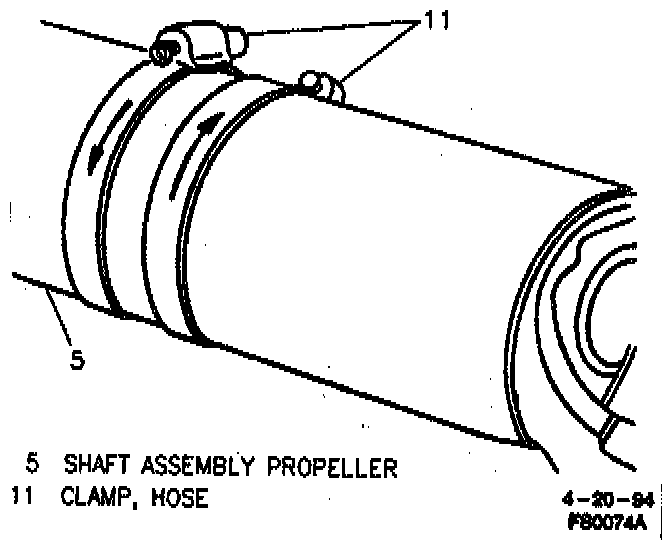
5. Install two clamps (11) on rear of propeller shaft (5) and slide them rearward until clamps (11) stop at nearest balance weight welded to tube.
- Align both clamps (11) at any one of four marks made on propeller shaft (5) in step 3 and tighten.
CAUTION: Do not run the vehicle faster than 88 km/h (55 mph). Stay clear of the universal joints and balance weight areas to avoid possible personal injury. Do not run the vehicle on the hoist for extended periods due to the danger of overheating the transmission or engine.
6. Run vehicle through speed range to 81-88 km/h (50-55 mph). Note amount of imbalance felt at front of rear axle housing.
7. Loosen clamps (11) and rotate clamp heads 90° to next mark on propeller shaft (5). Tighten clamps (11) and repeat step 6.
8. Repeat step 7 until vehicle has been run with clamp heads located at all four marks on propeller staff (5).
9. Position clamps (11) at point of least imbalance. Rotate clamp heads away from each other 45°, one on each side of the position.
a. Run vehicle and note if balance has improved.
b. In some cases it may be necessary to use one clamp (11) or possibly three clamps (11) in order to obtain good balance.
c. Replace propeller shaft (5) if three clamps (11) do not improve balance.
10. Continue to rotate clamps (11) apart in smaller angular increments until imbalance is at its minimum.
11. Remove wheel nuts.
12. Install tires and wheels.
13. Lower vehicle.
14. Road test vehicle to check final balance.
- A small vibration felt while the vehicle is on the hoist may not be noticed on road test.