Tire Mounting and Dismounting
Use a tire changing machine to mount or dismount tires. Follow the equipment manufacturer's instructions. Do not use hand tools or tire irons to change a tire as they may damage the tire beads, wheel rim or flanges.
Important: Do not lubricate the tire beads or wheel rim with a lubricant containing silicone. Silicone will allow the tire to rotate on the wheel rim, throwing the tire and wheel out of balance.
NOTICE: Do not attempt to break the tire bead loose before the tire has completely deflated. It takes about 70 seconds for the air to completely exhaust from a large tire. If the valve stem is removed before this amount of time, the bead breaker on the tire changing machine could put enough force on the tire to bend the wheel at the mounting surface. This could result in vibration, shimmy and cracking of the wheel. Completely deflate the tire before attempting to break the tire bead loose.
Rim bead seats should be cleaned with a wire brush or coarse steel wool to remove old rubber and light rust or corrosion. Before mounting or dismounting a tire, the bead area should be well-lubricated with GM P/N 9985555 (50 percent lubricant and 50 percent water) or equivalent.
CAUTION: To avoid serious personal injury, do not stand over the tire when inflating. Bead may break when bead snaps over safety hump. Do not exceed 220 kPa (32 psi) pressure when Inflating any tire if beads are not seated. If 220 kPa (32 psi) pressure will not seat beads, deflate, relubricate and reinflate. Over inflation may cause the bead to break and cause serious personal injury.
^ After mounting, inflate tire so that beads are completely seated, but never exceed 280 kPa (40 psi).
Important: When mounting blackwall tires, be sure the TPC specification number faces the outboard side of the vehicle.
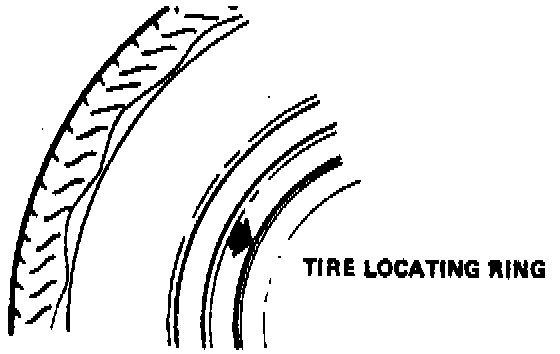
Install the valve stem and inflate to the pressure specified on the tire placard. Check the locating rings of the tire to be sure they show around the rim flanges on both sides of the wheel.