Radiator Cap: Description and Operation
WARNING: Do not remove radiator fill cap to check engine coolant level; check engine coolant at the coolant recovery reservoir. Engine coolant should be added only to the coolant recovery reservoir, when the system cools.CAUTION: As long as there is pressure in the cooling system, the temperature can be considerably higher than the boiling temperature of the solution. Removal of the radiator fill cap while engine is hot and pressure is high will cause the solution to boil Instantaneously and possibly with explosive force, spewing the solution over engine, fenders and person removing cap. If the solution contains flammable antifreeze, such as alcohol (not recommended for use at any time), there is also the possibility of causing a serious fire.
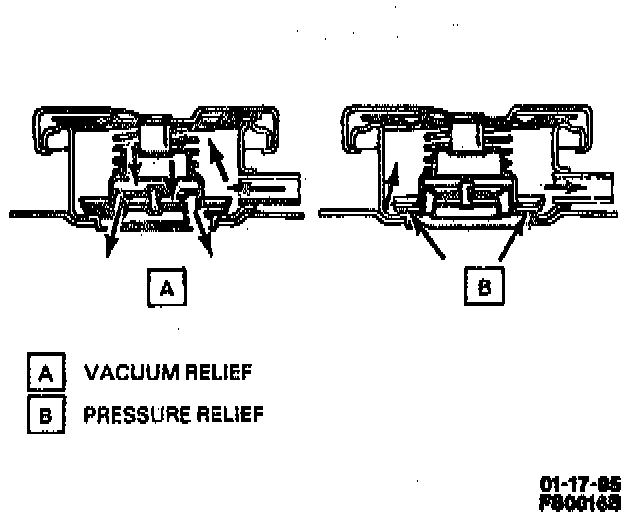
DESCRIPTION
A pressure type radiator fill cap is used with the cross-flow radiator to allow a buildup of 124 kPa (18 psi) in the cooling system. This pressure raises the boiling point of engine coolant to approximately 128° (262°) at sea level. The pressure type radiator fill cap contains a blow-off (pressure) valve and a vacuum (atmospheric) valve. The pressure valve is held against its seat by a heavy spring. This spring protects the radiator by relieving pressure exceeding 124 kPa (18 disc). To prevent radiator collapse caused by vacuum as the engine cools, the vacuum valve prevents excessive pressure differences from occurring between the cooling system and the atmosphere.
PURPOSE
The radiator fill cap has been designed without finger grips to discourage inadvertent removal. To safely remove the radiator fill cap, rotate the cap slowly counter-clockwise (do not press down) to detent. Allow any pressure to be relieved. Next, press down on the cap and continue to rotate cap counterclockwise and lift off the cap. Embossed on the cap is a caution against opening it and arrows indicating the proper closed position.