Evaporative Emission (EVAP) Hoses/Pipes Replacement - Tank/Tank
Evaporative Emission Hose/Pipe Replacement - Tank/Tank
Special Tool
J 34730-1A Fuel Pressure Gage
Removal Procedure
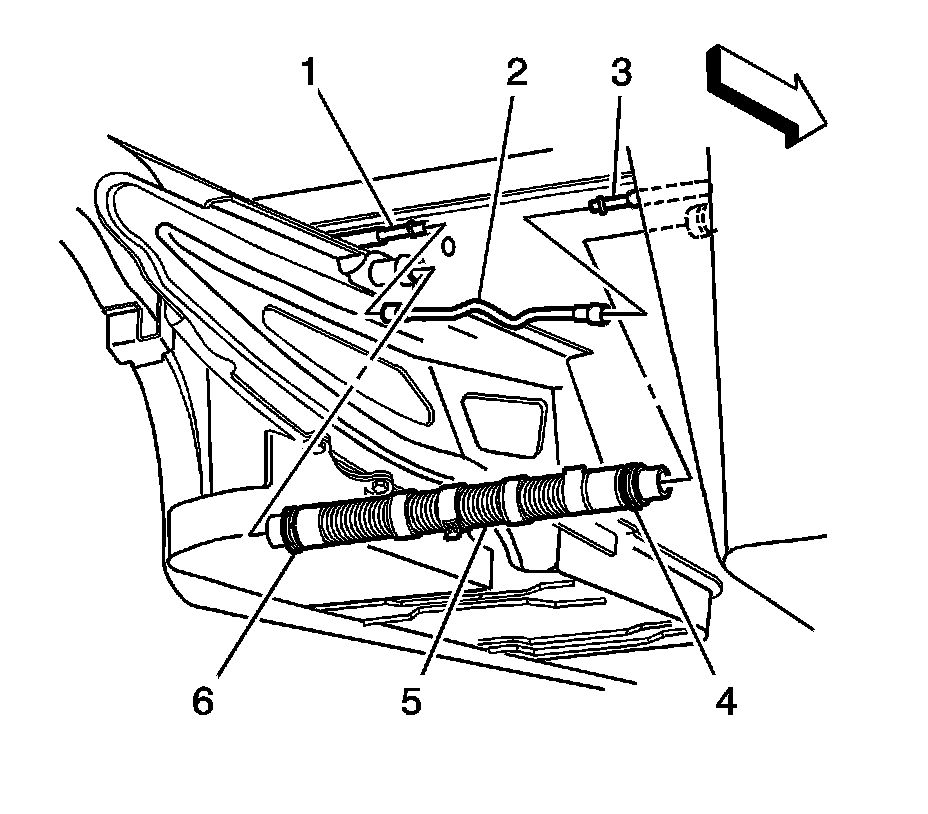
1. Disconnect the negative battery cable. Refer to Battery Negative Cable Disconnection and Connection (Service and Repair).
2. Relieve the fuel system pressure. Refer to Fuel Pressure Relief (With CH 48027) (Fuel Pressure Relief (With CH 48027))Fuel Pressure Relief (Without CH 48027) (Fuel Pressure Relief (Without CH 48027)).
3. Remove the fuel tank crossover tube. Refer to Fuel Tank Crossover Tube Replacement (Service and Repair).
4. Disconnect the EVAP pipe (2) at the right tank EVAP pipe (3) and the left tank EVAP pipe (1).
5. Remove the rear EVAP pipe (2).
6. Cap the open pipes in order to prevent possible contamination.
Installation Procedure
Caution: Replace the EVAP pipes and hoses with the original equipment or parts that meet the GM specifications for those parts. The replacement EVAP pipe must have the same type of fittings as the original pipe in order to ensure the integrity of the connection. When replacing EVAP hoses, use only reinforced fuel-resistant hose identified with the word Fluoroelastomer or GM 6163-M on the hose. The inside hose diameter must match the outside pipe diameter. Do not use rubber hose within 100 mm (4 in) of any part of the exhaust system or within 254 mm (10 in) of the catalytic converter.
1. Remove the caps from the pipes.
2. Connect the EVAP pipe (2) at the right tank EVAP pipe (3) and the left tank EVAP pipe (1).
3. Install the fuel tank crossover tube. Refer to Fuel Tank Crossover Tube Replacement (Service and Repair).
4. Install the right and left muffler. Refer to Exhaust Muffler Replacement - Right Side (Service and Repair) and Exhaust Muffler Replacement - Left Side (Service and Repair).
5. Refill the fuel system.
6. Tighten the fuel filler cap.
7. Connect the negative battery cable. Refer to Battery Negative Cable Disconnection and Connection (Service and Repair).
8. Use the following procedure in order to inspect for leaks:
1. Turn the ignition switch ON, with the engine OFF for 2 seconds.
2. Turn the ignition switch OFF, for 10 seconds.
3. Turn the ignition switch ON, with the engine OFF.
4. Inspect for fuel leaks.
9. Program the transmitters. Refer to Transmitter Programming (N. America and Japan, except Canada) (Programming and Relearning)Transmitter Programming (Canada and Europe) (Programming and Relearning)Transmitter Programming (New RCDLRs ONLY) (Programming and Relearning).