Leak Test
- Press the brake pedal with the engine running, then stop the engine. The brake pedal height should not very while pressed for 30 seconds. If the pedal height rises, go to step 6. If it does not rise, go to step 2.
- Start the engine and let it idle for 30 seconds. Turn the ignition switch off, and wait 30 seconds. Press the brake pedal several times using normal pressure. When the pedal is first pressed, it should be low. On consecutive applications, the pedal height should gradually rise. Does the pedal rise on each consecutive application? If it rises the booster is OK. If it does not go to step 3.
- Disconnect the brake booster vacuum hose (A) at the booster. The check valve (B) is built into the hose.
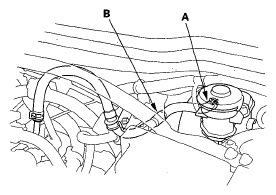 Courtesy of AMERICAN HONDA MOTOR CO., INC.
- Start the engine, and let it idle. There should be vacuum available. If no vacuum is available, the check valve is not working properly. Replace the brake booster vacuum hose and check valve, and retest. If vacuum is found, go to step 5.
- With the engine off, reconnect the vacuum hose to the brake booster.
- Start the engine, and then pinch the brake booster vacuum hose between the check valve and the booster.
- Turn the ignition switch off, and wait 30 seconds. Press the brake pedal several times using normal pressure. When the pedal is first pressed, it should be low. On consecutive applications, the pedal height should gradually rise.
- If the pedal position does not vary inspect the seal between the master cylinder and booster. If the seal is OK, replace the brake booster.
- If the pedal position varies, replace the brake booster vacuum hose/check valve assembly.