B2577
CIRCUIT DESCRIPTIONThe Body Control Module (BCM) controls the headlamp relay by grounding the control circuit of the headlamp.
CONDITIONS FOR RUNNING THE DTC
Voltage supplied to the module is in the normal operating voltage range (approximately 9-16 volts).
CONDITIONS FOR SETTING THE DTC
^ The BCM detects a short to ground or an open in the control circuit of the headlamp relay coil when the BCM is not energizing the headlamp relay.
^ The condition is present for more than 3 ms.
ACTION TAKEN WHEN THE DTC SETS
^ The BCM stores DTC B2577 in memory.
^ The SERVICE VEHICLE SOON telltale illuminates.
^ With the ignition in the RUN position, the BCM deactivates the daytime running lamps and turns on the park lamps.
CONDITIONS FOR CLEARING THE DTC
^ A current DTC B2577 clears if the BCM no longer detects a short to ground or an open in the control circuit of the headlamp relay coil.
^ A history DTC B2577 clears after 100 consecutive ignition cycles.
^ The BCM receives the Clear Code commend from the scan tool.
DIAGNOSTIC AIDS
^ If the DTC B2577 is a history DTC, the fault may be intermittent. Refer to Testing for Intermittent and Poor Connections in Diagrams.
^ An intermittent short to ground or an open in the following locations may cause an intermittent malfunction to occur:
- The control circuit of the headlamp relay coil
- The headlamp relay
- The BCM
TEST DESCRIPTION
Steps 1-13:
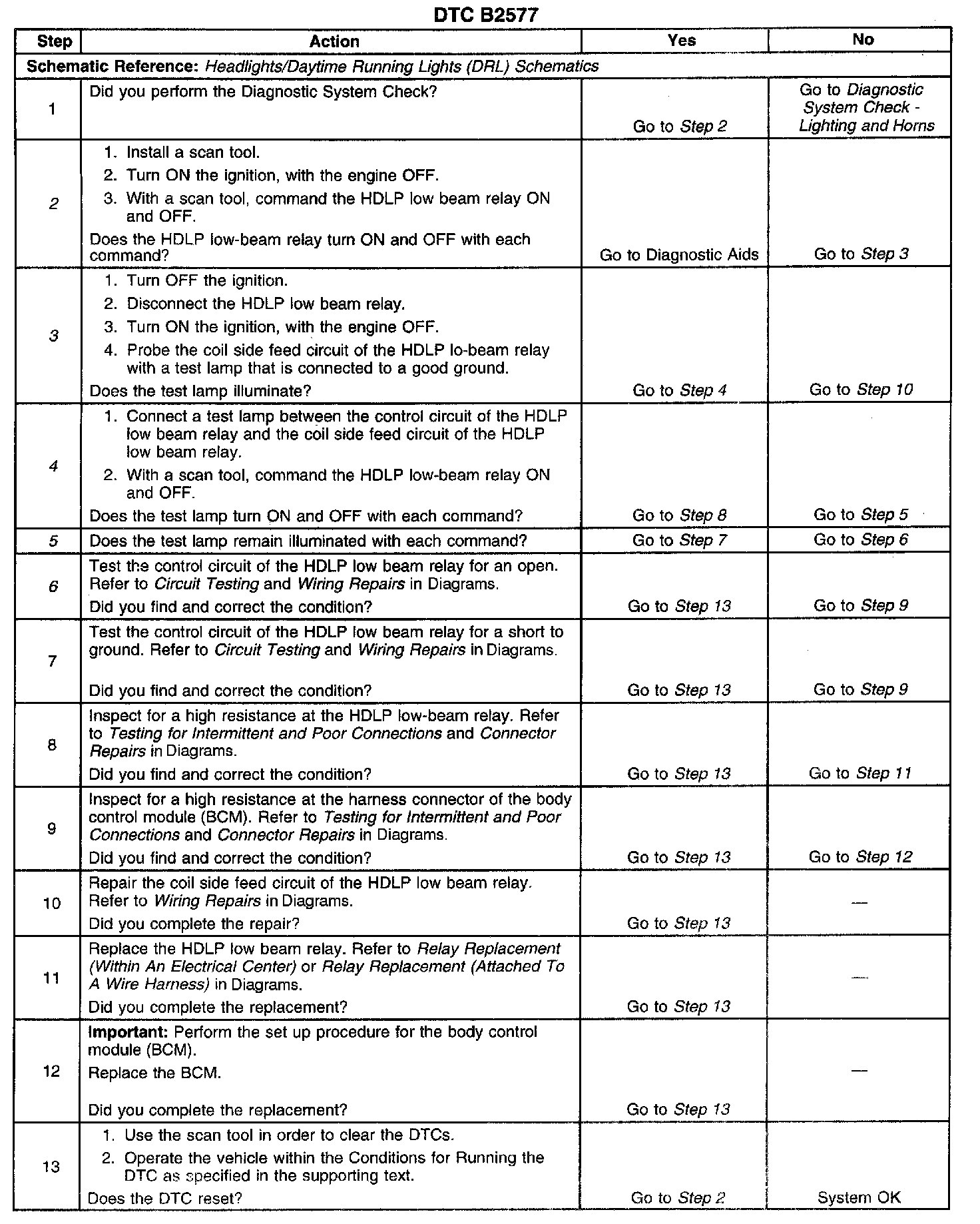
The number(s) below refer to the step number(s) on the diagnostic table.
2. Listen for an audible click when the HDLP low-beam relay operates. Command both the ON and OFF states. Repeat the commands as necessary.
3. This step tests for voltage at the coil side of the HDLP low-beam relay.
4. This step verifies that the Body Control Module (BCM) is providing ground to the HDLP low-beam relay.
5. This step tests whether ground is constantly being applied to the HDLP low-beam relay.
6. This step tests for a short to battery voltage.