Brake Caliper: Service and Repair
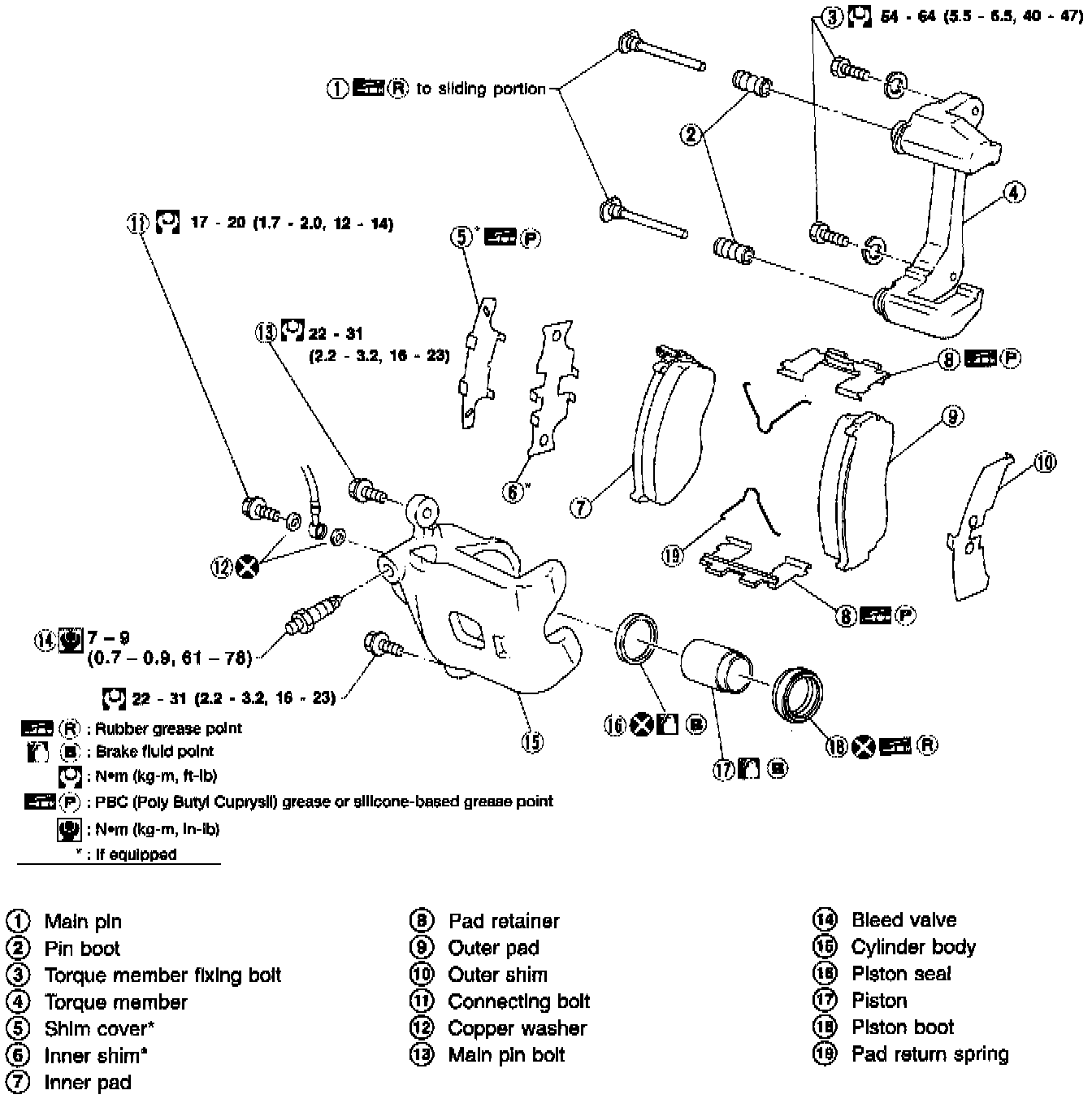
REMOVAL
WARNING: Clean brake pads with a vacuum dust collector to minimize the hazard of airborne particles or other materials.
CAUTION: Suspend caliper assembly with wire so as not to stretch brake hose.
Torque Member And Fixing Bolt Removal:
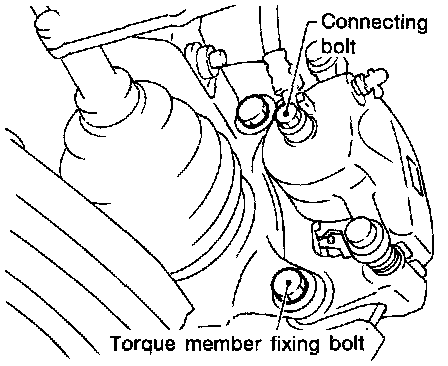
- Remove torque member fixing bolts and connecting bolt. It is not necessary to remove connecting bolt except for disassembly or replacement of caliper assembly. In this case, suspend caliper assembly with wire so as not to stretch brake hose.
DISASSEMBLY
WARNING: Do not place your fingers in front of piston.
CAUTION: Do not scratch or score cylinder wall.
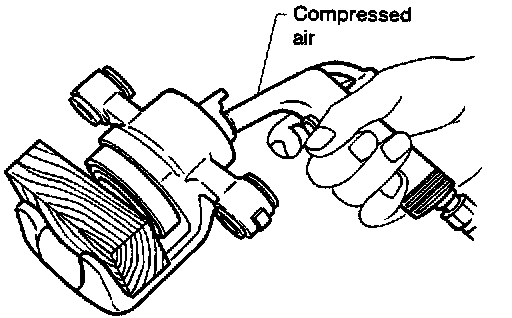
1. Push out piston and boot with compressed air.
2. Remove piston seal with a suitable tool.
INSPECTION
Cylinder Body
- Check inside surface of cylinder for score, rust, wear, damage or presence of foreign objects. If any of the above conditions are observed, replace cylinder body.
- Minor damage from rust or foreign objects may be eliminated by polishing surface with a fine emery paper. Replace cylinder body if necessary.
CAUTION: Use brake fluid to clean. Never use mineral oil.
Piston
- Check piston for scoring, rust, wear, damage or presence of foreign objects. Replace if any of the above conditions are observed.
CAUTION: Piston sliding surface is plated. Do not polish with emery paper even if rust or foreign objects are stuck to sliding surface.
Slide Pin, Pin Bolt And Pin Boot
- Check for wear, cracks or other damage. Replace if any of the above conditions are observed.
Rotor
Runout
1. Secure rotor to wheel hub with at least two nuts (M12 x 1.25).
Checking Rotor Runout:
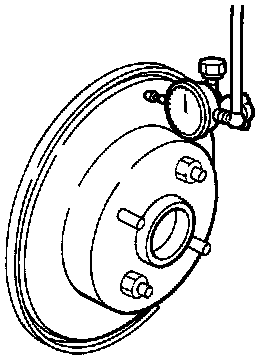
2. Check runout using a dial indicator.
Make sure that wheel bearing axial end play is within the specifications before measuring.
3. If the runout is out of specification, find minimum runout position as follows:
a. Remove nuts and rotor from wheel hub.
b. Shift the rotor one hole and secure rotor to wheel hub with nuts.
c. Measure runout.
d. Repeat steps a. through c. so that minimum runout position can be found.
4. If the runout is still out of specification, turn rotor with on-car brake lathe ("MAD, DL-8700", "AMMCO 700 and 705", or equivalent).
Thickness
Checking Thickness Variation:
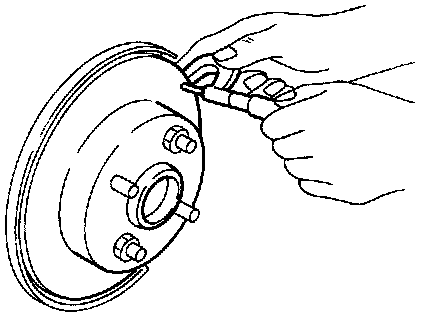
- Thickness variation (at least 8 Positions):
Thickness variation: 0.02 mm (0.0008 inch)
If thickness variation exceeds the specification, turn rotor with on-car brake lathe.
Rotor repair limit (minimum thickness): 16.0 mm (0.630 inch)
ASSEMBLY
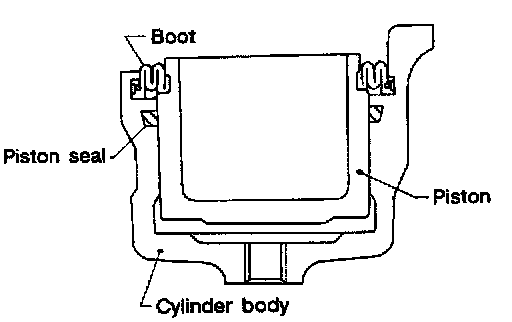
1. Insert piston seal into groove on cylinder body.
2. With piston boot fitted to piston, insert piston boot into groove on cylinder body and install piston.
3. Properly secure piston boot.
INSTALLATION
CAUTION:
- Refill with new brake fluid DOT 3.
- Never reuse drained brake fluid.
1. Install caliper assembly.
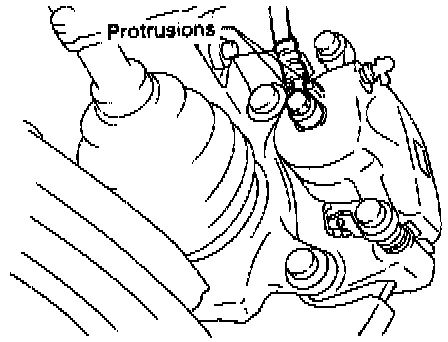
2. Install brake hose to caliper securely.
3. Install all parts and secure all bolts.
4. Bleed air. Refer to Brake Bleeding Procedure.