DTC 0702
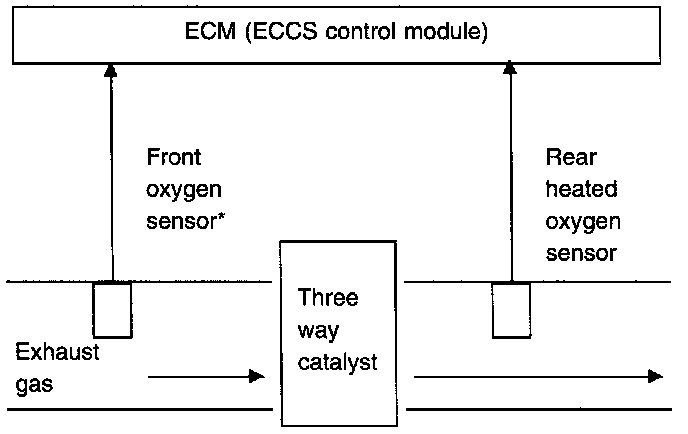
DESCRIPTION
The ECM monitors the switching frequency ratio of front oxygen sensor* and rear heated oxygen sensor.
A three way catalyst with high oxygen storage capacity will indicate a low switching frequency of rear heated oxygen sensor. As oxygen storage capacity decreases, the rear heated oxygen sensor switching frequency will increase.
When the frequency ratio of front oxygen sensor* and rear heated oxygen sensor approaches a specified limit value, the second stage diagnosis is applied.
The second stage diagnosis switches the mixture ratio feedback control using front oxygen sensor* to rear heated oxygen sensor.
Then ECM measures the switching lag time between front oxygen sensor* and rear heated oxygen sensor.
The longer lag time indicates the greater oxygen storage capacity. If the lag time is within the specified level, the three way catalyst malfunction is diagnosed.
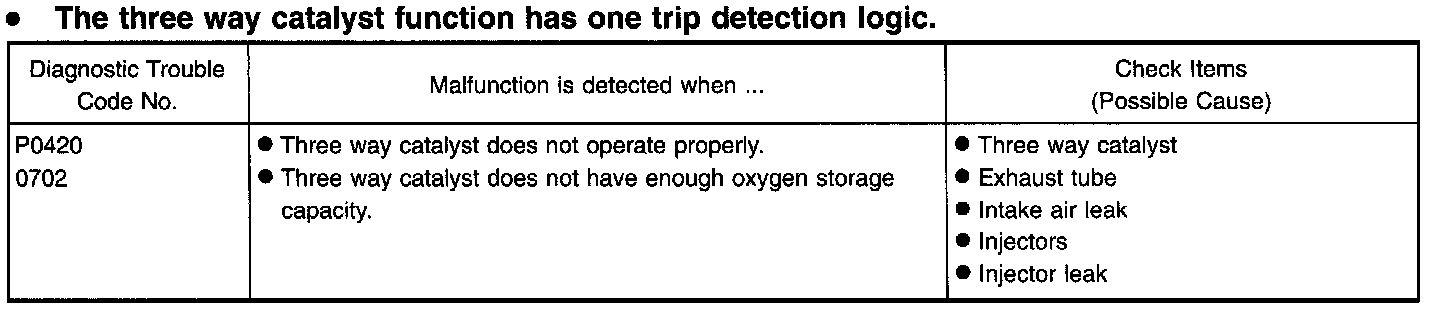
DIAGNOSTIC TROUBLE CODE CONFIRMATION PROCEDURE
ON-BOARD DIAGNOSIS LOGIC
Oxygen sensor (M/T models except for California) Heated oxygen sensor (M/T models for California and A/T models)
OVERALL FUNCTION CHECK
Use this procedure to check the overall function of the three way catalyst. During this check, a DTC might not be confirmed.
WITH CONSULT
1) Start engine and warm it up sufficiently.
2) Set "MAN U TRIG" and "HI SPEED", then select "FR O2 SENSOR", "RR O2 SENSOR", "FR O2 MNTR", "RR O2 MNTR" in "DATA MONITOR" mode with CONSULT.
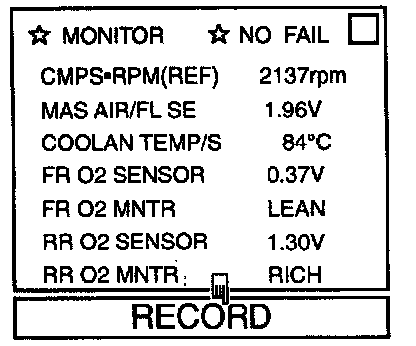
3) Touch "RECORD" on CONSULT screen with engine speed held at 2,000 rpm constant under no load.
4) Make sure that the switching frequency between "RICH" and "LEAN" of "RR O2 SENSOR" is very less than that of "FR O2 SENSOR".
Switching frequency ratio =
Rear heated oxygen sensor switching frequency / Front oxygen sensor switching frequency
This ratio should be less than 0.86.
If the ratio is greater than 0.86, the three way catalyst is not operating properly.
OR
WITH NO TOOLS
1) Start engine and warm it up sufficiently.
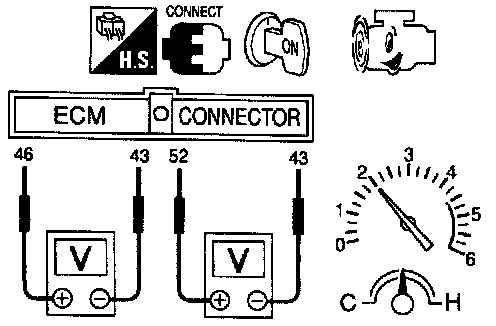
2) Set voltmeter probes between ECM terminals (46) (front oxygen sensor signal) and (43) (engine ground), and ECM terminals (52) (rear heated oxygen sensor signal) and (43) (engine ground).
3) Keep engine speed at 2,000 rpm constant under no load.
4) Make sure that the voltage switching frequency (high & low) between ECM terminals (52) and (43) is much less than that of ECM terminals (46) and (43).
Switching frequency ratio =
Rear heated oxygen sensor voltage switching frequency / Front oxygen sensor voltage switching frequency
This ratio should be less than 0.86.
If the ratio is greater than 0.86, it means three way catalyst does not operate properly.
NOTE: If the voltage at terminal (46) does not switch periodically more than 5 times within 10 seconds at step 3, perform TROUBLE DIAGNOSIS FOR DTC P0130 first.
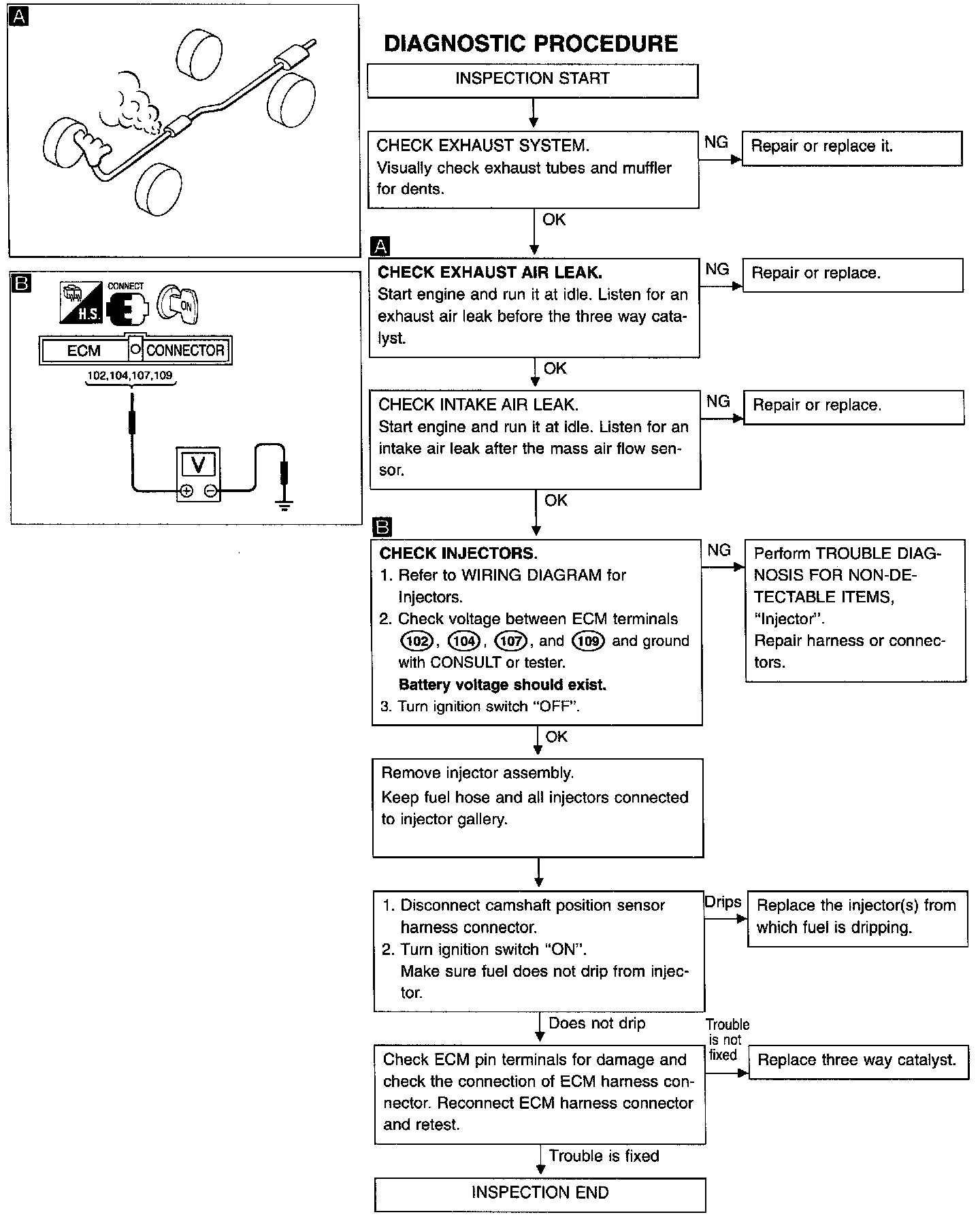
DIAGNOSTIC PROCEDURE